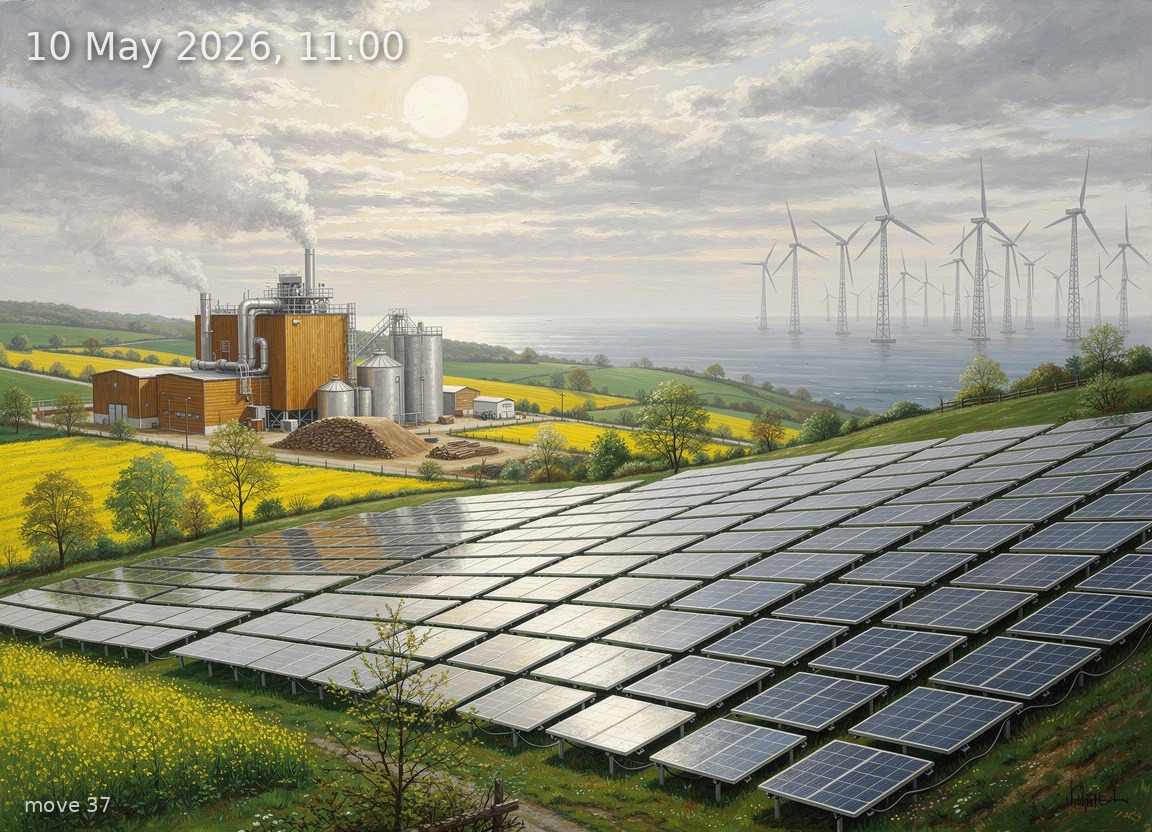
Solar at 41.6 GW drives 92% renewable share and mild negative prices amid light winds and high cloud.
Back
Generation mix
Wind onshore 3%
Wind offshore 5%
Solar 74%
Biomass 7%
Hydro 2%
Natural gas 3%
Hard coal 1%
Brown coal 4%
92%
Renewable share
4.7 GW
Wind (on + offshore)
41.6 GW
Solar
56.0 GW
Total generation
+12.2 GW
Net export
-0.7 €/MWh
Day-ahead price
16.4°C / 2 km/h
Temp / Wind speed
Open-Meteo, Kassel (51.3°N 9.5°E)
91% / 345.0 W/m²
Cloud cover / Radiation
54
gCO₂/kWh
Image prompt
Solar 41.6 GW dominates the entire panorama as vast fields of aluminium-framed crystalline silicon photovoltaic panels stretching across rolling central German farmland, covering roughly three-quarters of the scene; wind offshore 3.0 GW appears in the far-right background as a cluster of tall three-blade turbines rising from a hazy sea horizon; wind onshore 1.6 GW shows as a handful of barely-turning lattice-tower turbines on a distant ridge; biomass 4.0 GW occupies the mid-left as a timber-clad biomass plant with a modest steam plume and wood-chip storage yard; brown coal 2.4 GW sits at the far left as a pair of hyperbolic cooling towers with thin lazy steam columns beside a lignite conveyor belt and open-pit mine edge; natural gas 1.7 GW appears as a compact CCGT facility with a single tall exhaust stack and faint heat shimmer near the biomass plant; hydro 1.4 GW is suggested by a small dam and spillway in a wooded valley in the middle distance; hard coal 0.4 GW is a single dark smokestack barely visible behind the cooling towers. Time is 11:00 AM in May — full diffuse daylight under a high, bright overcast sky at 91% cloud cover, the sun's disc faintly visible as a bright white spot through thin stratiform cloud, light even and shadowless, giving the landscape a luminous silvery quality. Temperature 16°C, lush green spring vegetation, fresh beech and oak leaves, rapeseed fields in yellow bloom between solar arrays. Wind is almost nil — grass upright, no motion in foliage, turbine blades frozen or creeping. The atmosphere is calm and expansive, open sky suggesting low electricity prices. Highly detailed oil painting in the tradition of 19th-century German Romantic landscape masters — Caspar David Friedrich's atmospheric depth merged with industrial precision — rich layered colour, visible confident brushwork, golden-green spring palette, meticulous engineering detail on every turbine nacelle, every PV module frame, every cooling tower's concrete curve and ribbing. No text, no labels.