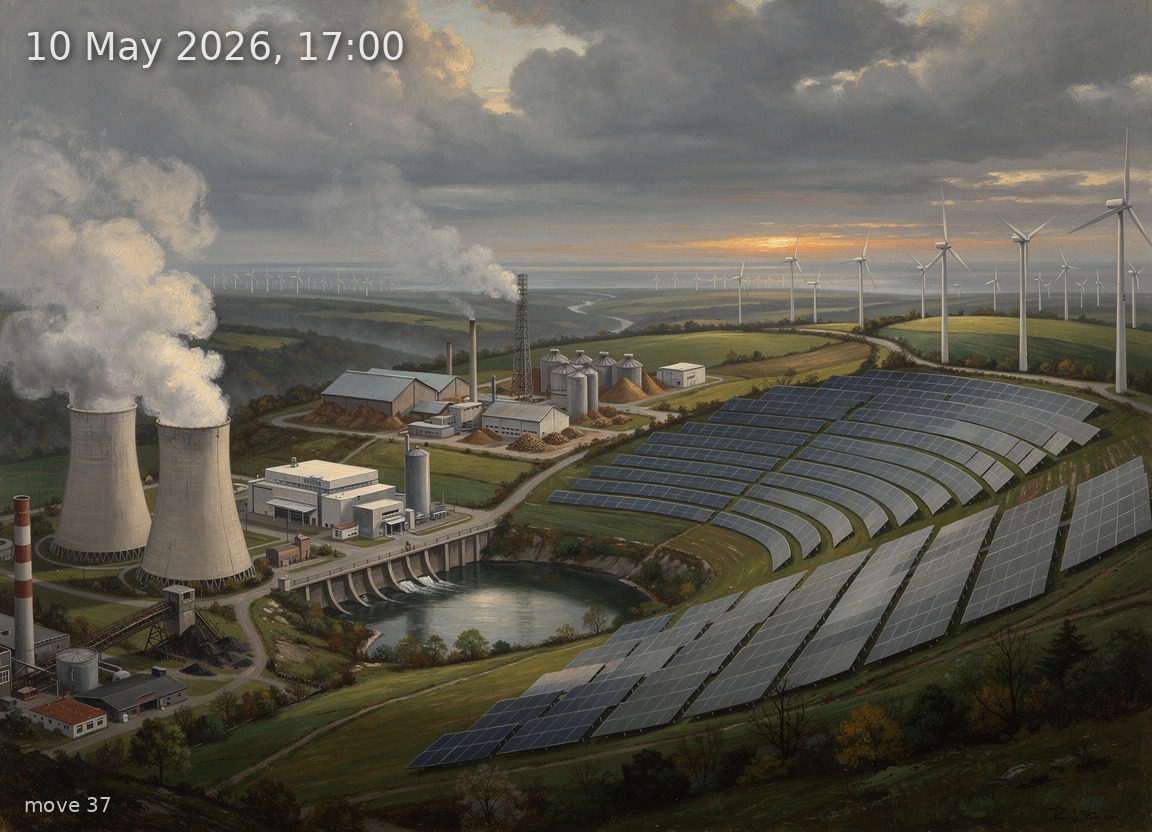
Solar leads at 18.6 GW with wind at 10.4 GW as late-afternoon demand meets declining renewable output.
Back
Generation mix
Wind onshore 19%
Wind offshore 6%
Solar 45%
Biomass 10%
Hydro 3%
Natural gas 5%
Hard coal 2%
Brown coal 9%
84%
Renewable share
10.4 GW
Wind (on + offshore)
18.6 GW
Solar
41.5 GW
Total generation
-0.1 GW
Net import
71.0 €/MWh
Day-ahead price
20.7°C / 10 km/h
Temp / Wind speed
Open-Meteo, Kassel (51.3°N 9.5°E)
96% / 249.0 W/m²
Cloud cover / Radiation
114
gCO₂/kWh
Image prompt
Solar 18.6 GW dominates the centre-right of the scene as vast fields of aluminium-framed crystalline silicon PV panels stretching across rolling green farmland, their surfaces reflecting a dim pewter sky; wind onshore 7.8 GW fills the far right as dozens of three-blade turbines on tall lattice and tubular towers, blades turning slowly in light breeze; wind offshore 2.6 GW appears as a distant cluster of turbines on the hazy horizon line; brown coal 3.8 GW occupies the left foreground as a lignite power station with two massive hyperbolic cooling towers emitting thick white steam plumes; biomass 4.2 GW sits behind the coal station as a cluster of squat industrial buildings with wood-chip silos and thin exhaust stacks; natural gas 2.2 GW appears as a compact CCGT plant with a single tall exhaust stack and a smaller steam plume, positioned centre-left; hydro 1.4 GW is represented by a small dam and reservoir visible in a valley in the mid-ground; hard coal 0.7 GW shows as a single smaller coal plant with a conventional smokestack at the far left edge. TIME AND LIGHTING: 17:00 dusk in May — the sky is heavily overcast at 96% cloud cover, a thick blanket of grey stratus with only a faint orange-amber glow along the lower western horizon where the sun is descending behind clouds, upper sky darkening toward slate blue. The atmosphere feels heavy and somewhat oppressive reflecting a 71 EUR/MWh price. Temperature is a mild 20.7°C; vegetation is lush late-spring green with wildflowers in meadows, deciduous trees in full fresh leaf. Rendered as a highly detailed oil painting in the tradition of 19th-century German Romantic landscape painters — rich muted colour palette of grey, green, amber and steel blue, visible confident brushwork, atmospheric depth with misty distance, dramatic chiaroscuro where the fading horizon light catches the cooling tower steam. Every technology rendered with meticulous engineering accuracy: turbine nacelles with three-blade rotors, PV panel grid patterns, hyperbolic concrete cooling tower geometry, CCGT exhaust details. No text, no labels.