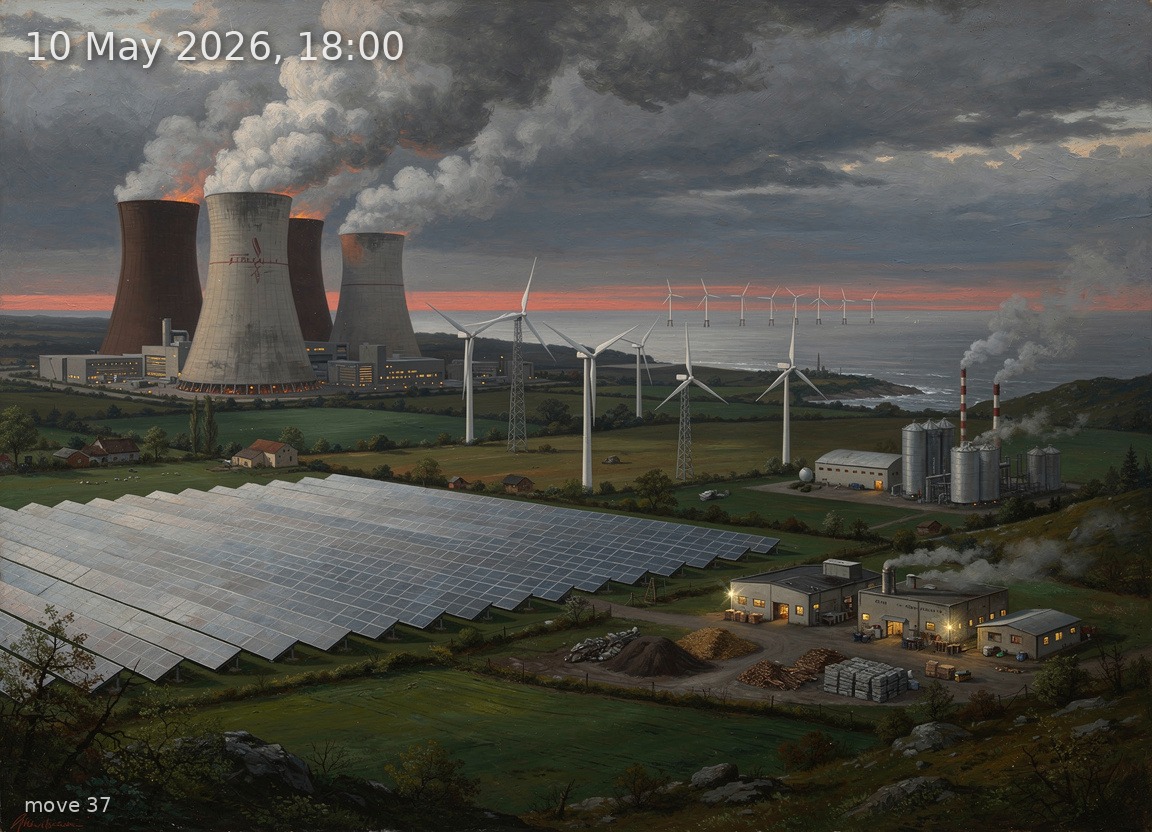
Wind and solar lead at 22.7 GW combined, but evening demand of 44.3 GW requires coal, gas, and 4.1 GW net imports.
Back
Generation mix
Wind onshore 24%
Wind offshore 7%
Solar 26%
Biomass 11%
Hydro 3%
Natural gas 8%
Hard coal 6%
Brown coal 16%
71%
Renewable share
12.2 GW
Wind (on + offshore)
10.5 GW
Solar
40.2 GW
Total generation
-4.1 GW
Net import
110.9 €/MWh
Day-ahead price
20.5°C / 10 km/h
Temp / Wind speed
Open-Meteo, Kassel (51.3°N 9.5°E)
100% / 135.0 W/m²
Cloud cover / Radiation
208
gCO₂/kWh
Image prompt
Panoramic scene at dusk, 18:00 in May — the lower horizon glows with a fading orange-red band, the sky above deepening into slate grey and indigo, fully overcast with heavy, oppressive cloud cover suggesting high electricity prices. Composition proportional to generation shares across 40.2 GW total: Brown coal 6.2 GW dominates the far left as a cluster of massive hyperbolic cooling towers with thick white-grey steam plumes merging into the overcast ceiling, glowing faintly orange from internal furnace light; Solar 10.5 GW occupies the left-centre as an extensive field of aluminium-framed crystalline silicon PV panels stretching across gentle green farmland, their surfaces reflecting the dull grey sky with no direct sunlight, only diffuse illumination; Wind onshore 9.6 GW spans the centre as dozens of tall three-blade turbines on lattice and tubular towers across rolling hills, blades turning slowly in moderate breeze; Wind offshore 2.6 GW appears in the far centre-right as a row of larger offshore turbines on monopile foundations visible across a distant grey sea horizon; Biomass 4.4 GW sits right of centre as a cluster of modest industrial buildings with short stacks emitting thin wisps of pale smoke, surrounded by wood chip piles; Natural gas 3.1 GW appears as two compact CCGT units with single tall exhaust stacks emitting transparent heat shimmer, lit by warm industrial lighting beginning to switch on; Hard coal 2.3 GW is rendered as a smaller power station with a single large chimney and conveyor belts feeding dark coal into hoppers; Hydro 1.4 GW appears in the far right as a concrete dam set into a forested valley with water cascading through turbine outlets. The overall atmosphere is heavy and warm — lush green deciduous trees in full spring leaf at 20.5°C, wildflowers in meadows, but the sky presses down with complete cloud cover. Sodium streetlights along a road are just beginning to flicker on. Highly detailed oil painting in the tradition of 19th-century German Romantic landscape painters — rich saturated colour, visible expressive brushwork, deep atmospheric perspective, dramatic chiaroscuro where the last dusk light catches the steam plumes and turbine blades. Meticulous engineering accuracy on every technology. No text, no labels.