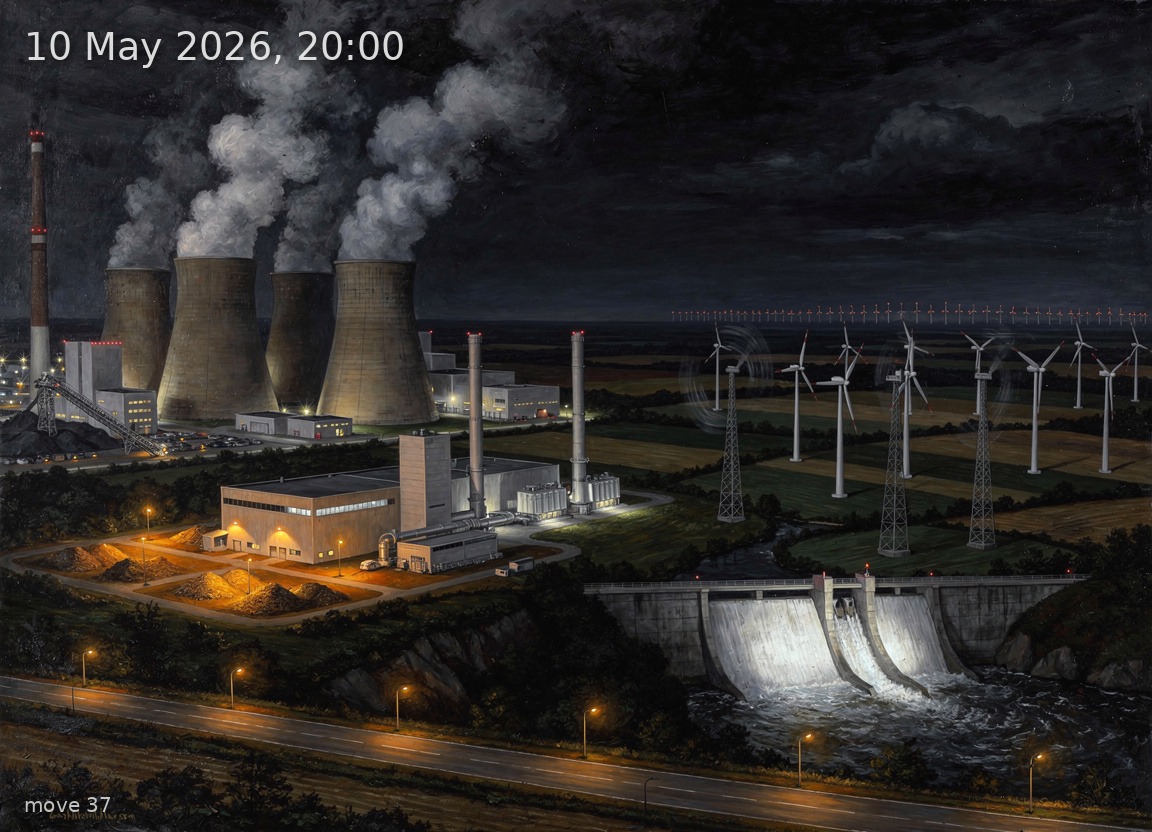
Lignite, wind, and biomass anchor a 34.6 GW domestic stack while 13.9 GW of net imports meet evening peak demand.
Back
Generation mix
Wind onshore 30%
Wind offshore 6%
Solar 2%
Biomass 13%
Hydro 4%
Natural gas 12%
Hard coal 10%
Brown coal 23%
55%
Renewable share
12.3 GW
Wind (on + offshore)
0.6 GW
Solar
34.6 GW
Total generation
-13.9 GW
Net import
129.3 €/MWh
Day-ahead price
18.2°C / 10 km/h
Temp / Wind speed
Open-Meteo, Kassel (51.3°N 9.5°E)
100% / 2.0 W/m²
Cloud cover / Radiation
325
gCO₂/kWh
Image prompt
Brown coal 7.9 GW dominates the left quarter of the scene as a massive lignite power station with four hyperbolic cooling towers releasing thick white steam plumes into a black night sky; wind onshore 10.3 GW fills the centre-right as dozens of tall three-blade turbines on lattice and tubular towers stretching across rolling central German farmland, their red aviation warning lights blinking against the darkness; wind offshore 2.0 GW appears as a distant cluster of turbines on the far-right horizon with tiny red lights; biomass 4.5 GW sits as a mid-sized industrial plant with a rectangular stack and woodchip storage yard, warmly lit by sodium lamps, positioned centre-left; natural gas 4.2 GW is rendered as two compact CCGT units with single tall exhaust stacks and visible heat shimmer, placed between the lignite station and the biomass plant; hard coal 3.6 GW appears as a smaller coal-fired station with a single large smokestack and conveyor belt, adjacent to the lignite complex on the far left; hydro 1.5 GW is a concrete dam structure visible in the middle distance with floodlit spillway; solar 0.6 GW is represented only as barely visible darkened aluminium-framed PV panels on a nearby rooftop, unlit and inactive. The sky is completely dark — a deep navy-black overcast night with 100% cloud cover, no stars, no moon, no twilight glow whatsoever. The only illumination comes from amber sodium streetlights lining a road in the foreground, the warm industrial glow of the power stations, and the red aviation lights on the turbines. The atmosphere is heavy and oppressive, reflecting the high electricity price — humid air thickens around the cooling tower plumes. Vegetation is lush late-spring green where visible under artificial light, with 18°C warmth suggested by open windows in a distant village with glowing panes. Moderate wind animates the scene: grass bends gently, turbine blades show motion blur. High-voltage transmission lines cross the scene, symbolising the massive import flows. Style: highly detailed oil painting in the tradition of 19th-century German Romantic landscape painters such as Caspar David Friedrich and Carl Blechen, with rich impasto brushwork, deep chiaroscuro, atmospheric sfumato in the steam plumes, and luminous contrast between industrial fire-glow and enveloping darkness — yet every piece of engineering rendered with meticulous technical accuracy: three-blade rotor profiles, nacelle housings, hyperbolic concrete shell geometry, CCGT exhaust ductwork. No text, no labels.