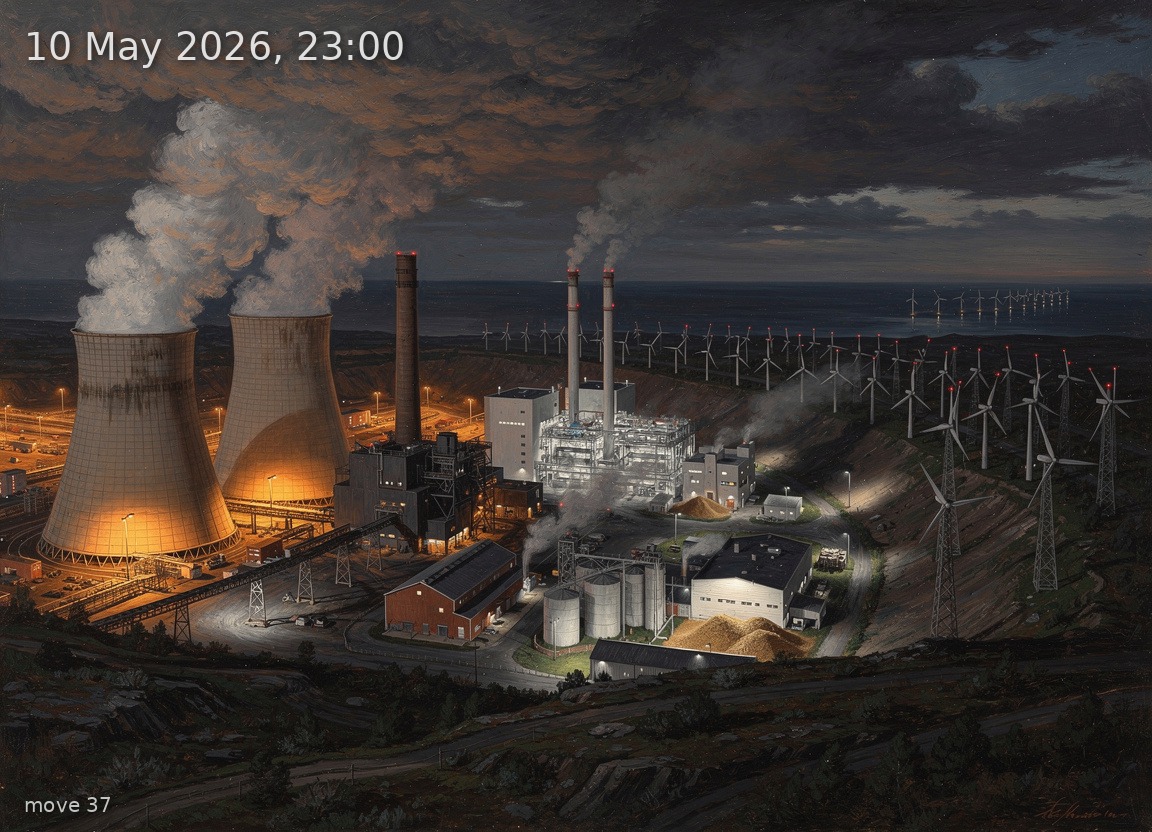
Brown coal, wind, and gas anchor a night grid running an 11 GW net import under full overcast.
Back
Generation mix
Wind onshore 31%
Wind offshore 3%
Biomass 13%
Hydro 4%
Natural gas 15%
Hard coal 11%
Brown coal 22%
52%
Renewable share
11.0 GW
Wind (on + offshore)
0.0 GW
Solar
32.3 GW
Total generation
-11.1 GW
Net import
119.8 €/MWh
Day-ahead price
11.8°C / 9 km/h
Temp / Wind speed
Open-Meteo, Kassel (51.3°N 9.5°E)
100% / 0.0 W/m²
Cloud cover / Radiation
340
gCO₂/kWh
Image prompt
Brown coal 7.2 GW dominates the left quarter of the scene as a massive lignite power station with three hyperbolic cooling towers emitting thick white steam plumes lit from below by orange sodium lamps; natural gas 4.9 GW appears left of centre as two compact CCGT units with tall single exhaust stacks venting thin heat shimmer; hard coal 3.6 GW sits at centre-left as a darker, blockier power station with a single large chimney and coal conveyor silhouette; biomass 4.2 GW occupies the centre as a cluster of medium-sized industrial buildings with wood-chip silos and modest stacks emitting faint grey vapour; wind onshore 10.1 GW spans the entire right third as a long ridge of numerous three-blade turbines on lattice and tubular towers, red aviation warning lights blinking at their nacelles; wind offshore 0.9 GW appears as a few distant turbines on the far-right horizon above a dark water line; hydro 1.4 GW is suggested by a small dam structure with spillway foam visible in the mid-ground between the thermal plants and the wind ridge. The sky is completely black with 100% cloud cover — no stars, no moon, no twilight glow, only a deep charcoal-navy ceiling pressing down oppressively, reflecting the high 119.8 EUR/MWh price. All illumination comes from industrial sources: sodium-orange and mercury-white floodlights on plant structures, glowing furnace mouths, red blinking turbine lights, and scattered amber windows in distant town buildings. Spring vegetation — fresh green grass, budding deciduous trees — is barely visible in the foreground under artificial light spill, temperature around 12°C suggesting mild damp air with possible mist tendrils near the ground. Light wind animates the turbine blades at moderate speed. Style: highly detailed oil painting in the tradition of 19th-century German Romantic landscape masters — rich impasto brushwork, deep chiaroscuro, dramatic atmospheric depth — yet with meticulous engineering accuracy on every turbine nacelle, cooling tower parabolic profile, CCGT stack, and conveyor structure. The mood is solemn industrial sublime. No text, no labels.