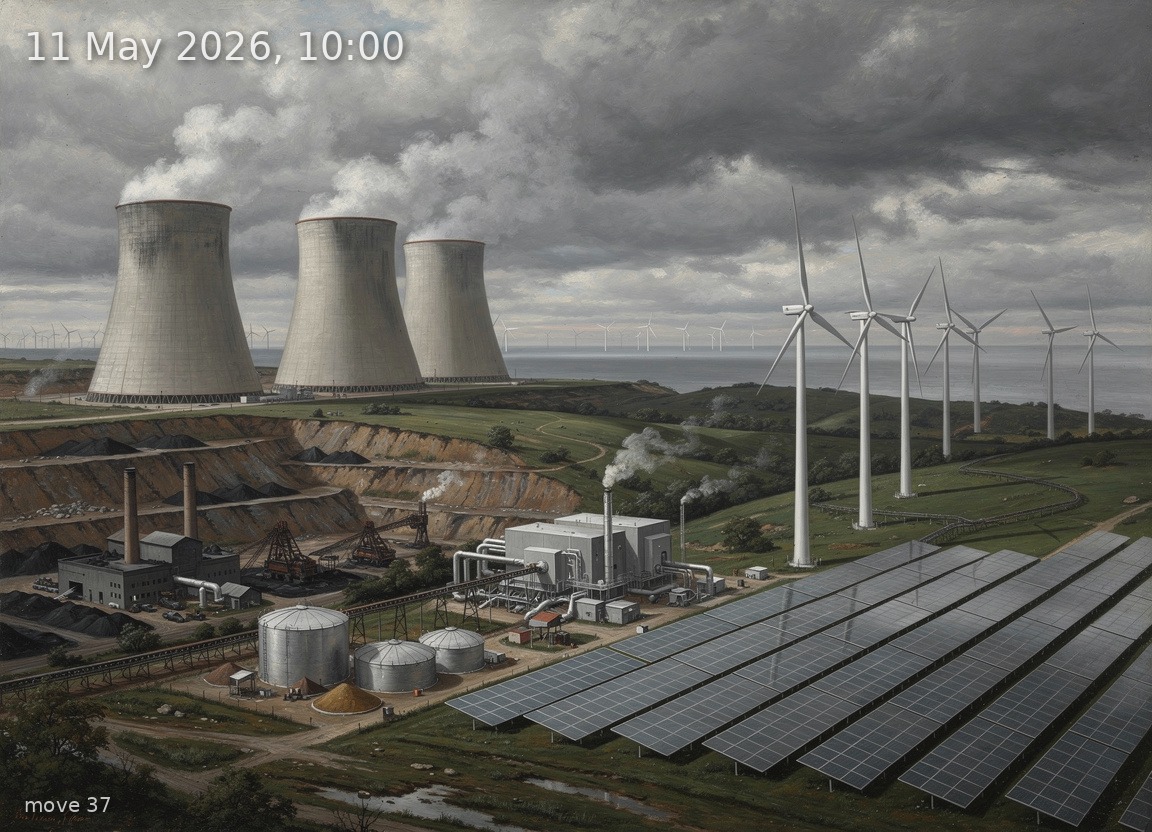
Wind and diffuse solar lead at 73 % renewables, but full overcast and high demand drive 9.7 GW net imports and elevated prices.
Back
Generation mix
Wind onshore 23%
Wind offshore 5%
Solar 34%
Biomass 8%
Hydro 3%
Natural gas 6%
Hard coal 6%
Brown coal 14%
73%
Renewable share
14.7 GW
Wind (on + offshore)
17.9 GW
Solar
52.3 GW
Total generation
-9.7 GW
Net import
126.3 €/MWh
Day-ahead price
8.3°C / 10 km/h
Temp / Wind speed
Open-Meteo, Kassel (51.3°N 9.5°E)
100% / 3.0 W/m²
Cloud cover / Radiation
195
gCO₂/kWh
Image prompt
Solar 17.9 GW occupies the right third as vast fields of aluminium-framed crystalline silicon PV panels stretching across flat farmland, their surfaces dull and unreflective under heavy cloud; wind onshore 12.0 GW spans the centre-right as dozens of tall three-blade turbines with white tubular towers and detailed nacelles turning slowly in light breeze across rolling hills; wind offshore 2.7 GW appears as a distant cluster of turbines on the far horizon above a grey sea glimpsed through a gap in the terrain; brown coal 7.4 GW dominates the left quarter as three massive hyperbolic cooling towers emitting thick white steam plumes, flanked by conveyor belt infrastructure and open-pit mine scarring; hard coal 3.3 GW sits left-centre as a dark industrial plant with tall rectangular chimneys and coal stockpiles; natural gas 3.3 GW appears as two compact CCGT units with slim exhaust stacks and modest heat shimmer; biomass 4.1 GW is rendered as a mid-ground cluster of cylindrical digesters and small wood-chip silos with thin vapour trails; hydro 1.4 GW is a small concrete dam and reservoir nestled in a wooded valley at the far left edge. The sky is entirely overcast with thick, low, oppressive stratiform clouds in tones of pewter and slate grey—no sunlight breaks through, and direct radiation is nearly zero, casting flat diffuse daylight across the entire scene with no shadows. The atmosphere feels heavy and pressured, evoking the high electricity price. The landscape is mid-spring with fresh pale-green foliage on birch and beech trees, but the grass is damp and muted under cool 8 °C air. Overhead transmission lines on lattice pylons cross the scene, symbolising import flows. Painted in the style of a highly detailed 19th-century German Romantic oil painting—rich impasto brushwork, atmospheric aerial perspective with hazy industrial distance, meticulous engineering accuracy on every turbine blade, cooling tower curve, and panel frame, deep tonal range from warm browns of coal infrastructure to cool grey-greens of the overcast countryside. No text, no labels.