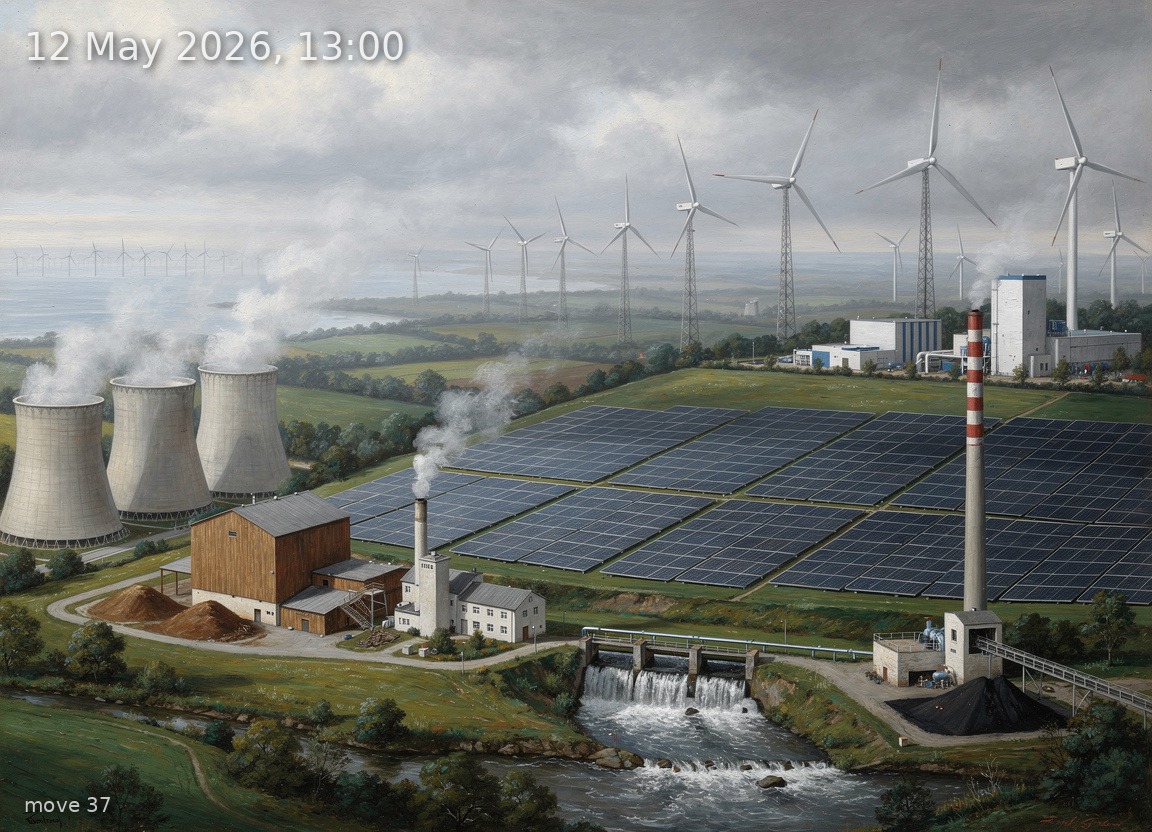
Wind and diffuse solar together supply 81% of generation, driving 13 GW of net exports at low prices.
Back
Generation mix
Wind onshore 35%
Wind offshore 6%
Solar 41%
Biomass 5%
Hydro 2%
Natural gas 3%
Hard coal 2%
Brown coal 6%
89%
Renewable share
28.7 GW
Wind (on + offshore)
29.2 GW
Solar
71.2 GW
Total generation
+13.2 GW
Net export
27.3 €/MWh
Day-ahead price
8.2°C / 14 km/h
Temp / Wind speed
Open-Meteo, Kassel (51.3°N 9.5°E)
93% / 98.0 W/m²
Cloud cover / Radiation
79
gCO₂/kWh
Image prompt
Solar 29.2 GW dominates the centre-right as vast fields of aluminium-framed crystalline silicon PV panels stretching across rolling farmland under diffuse grey-white light; wind onshore 24.7 GW fills the far background and left horizon as dozens of tall three-blade turbines on lattice and tubular towers, rotors turning steadily in moderate wind; wind offshore 4.0 GW appears as a distant line of turbines rising from a hazy river or sea horizon at the far left; brown coal 4.0 GW occupies the left foreground as a cluster of massive hyperbolic cooling towers emitting thick white steam plumes; biomass 3.9 GW sits beside the coal plant as a timber-clad industrial facility with a smaller smokestack and woodchip storage; natural gas 2.4 GW appears as a compact CCGT plant with a single tall exhaust stack and a modest heat shimmer; hard coal 1.5 GW is rendered as a smaller conventional power station with a single rectangular cooling tower and coal conveyor; hydro 1.4 GW is visible as a weir and small run-of-river powerhouse on a stream in the mid-ground. The time is 1 PM in central Germany in mid-May: full daylight but heavily overcast at 93% cloud cover, so the sky is a uniform bright silver-grey with no direct sun, casting soft diffuse shadows. The light is flat and luminous but not gloomy. The air temperature is a cool 8°C in spring, so vegetation is fresh bright green but people in the scene wear light jackets; trees are fully leafed but grass is lush, with spring wildflowers. Wind at 14 km/h bends long grass gently. The low day-ahead price is suggested by calm, open composition with generous negative space in the sky. Style: a highly detailed oil painting in the tradition of 19th-century German Romantic landscape painters such as Caspar David Friedrich and Carl Blechen—rich layered colour, visible confident brushwork, atmospheric aerial perspective with depth receding into misty distance—but with meticulous modern technical accuracy in every turbine nacelle, PV cell grid pattern, cooling tower curvature, and industrial pipe. The scene feels monumental yet serene, an industrial pastoral. No text, no labels, no people in foreground.