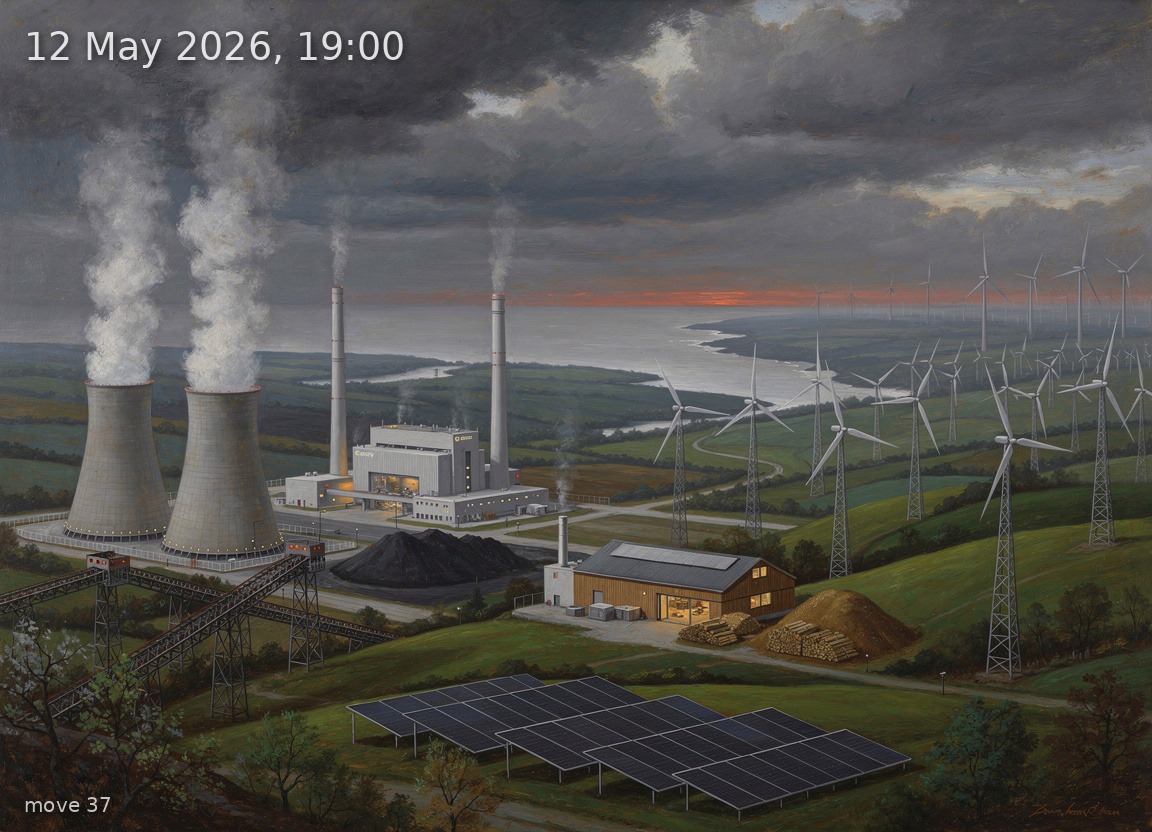
Wind leads at 18.8 GW but fading solar and high thermal dispatch drive prices to 136 EUR/MWh at dusk.
Back
Generation mix
Wind onshore 32%
Wind offshore 8%
Solar 8%
Biomass 10%
Hydro 4%
Natural gas 12%
Hard coal 10%
Brown coal 16%
62%
Renewable share
18.8 GW
Wind (on + offshore)
3.7 GW
Solar
46.4 GW
Total generation
-6.1 GW
Net import
136.3 €/MWh
Day-ahead price
9.7°C / 11 km/h
Temp / Wind speed
Open-Meteo, Kassel (51.3°N 9.5°E)
92% / 34.0 W/m²
Cloud cover / Radiation
266
gCO₂/kWh
Image prompt
Wind onshore 15.0 GW dominates the right half of the scene as dozens of three-blade turbines on lattice towers stretching across rolling green hills, their rotors turning steadily in moderate wind; wind offshore 3.8 GW appears as a cluster of taller turbines visible on the far-right horizon above a grey sea inlet. Brown coal 7.6 GW occupies the left foreground as three massive hyperbolic cooling towers with thick white-grey steam plumes rising into the overcast, surrounded by lignite conveyor infrastructure. Natural gas 5.7 GW sits centre-left as two compact CCGT plants with tall slender exhaust stacks emitting thin translucent heat shimmer. Hard coal 4.4 GW appears as a single large coal-fired station with a rectangular boiler house and a wide chimney beside a coal stockpile, positioned just left of centre. Biomass 4.5 GW is rendered as a timber-clad CHP facility with a modest smokestack and stacked woodchip storage, placed between the coal and gas plants. Solar 3.7 GW appears as a modest field of aluminium-framed crystalline silicon panels in the centre foreground, their surfaces dark and unreflective under the overcast sky, catching only the faintest remnant glow. Hydro 1.7 GW is visible as a small concrete run-of-river weir and powerhouse tucked into a stream valley at the far left edge. The lighting is late dusk at 19:00 in May in central Germany: the sky is deeply overcast at 92% cloud cover, with only a narrow band of dull orange-red glow along the lowest western horizon, the upper sky darkening rapidly toward slate grey and near-navy overhead. Temperature is a cool 9.7°C; spring foliage on deciduous trees is fresh but subdued in the fading light, grass is vivid green. The atmosphere is heavy and oppressive, hinting at the high electricity price—low clouds press down, the air feels dense and still despite the moderate wind driving the turbines. Sodium streetlights along an access road begin to flicker on. Highly detailed oil painting in the tradition of 19th-century German Romantic landscape painters such as Caspar David Friedrich and Carl Blechen—rich, moody colour palette of slate blues, ochres, warm coal-fire oranges, and cool greens; visible impasto brushwork; atmospheric depth with aerial perspective softening distant turbines; meticulous engineering detail on every technology. No text, no labels, no people.