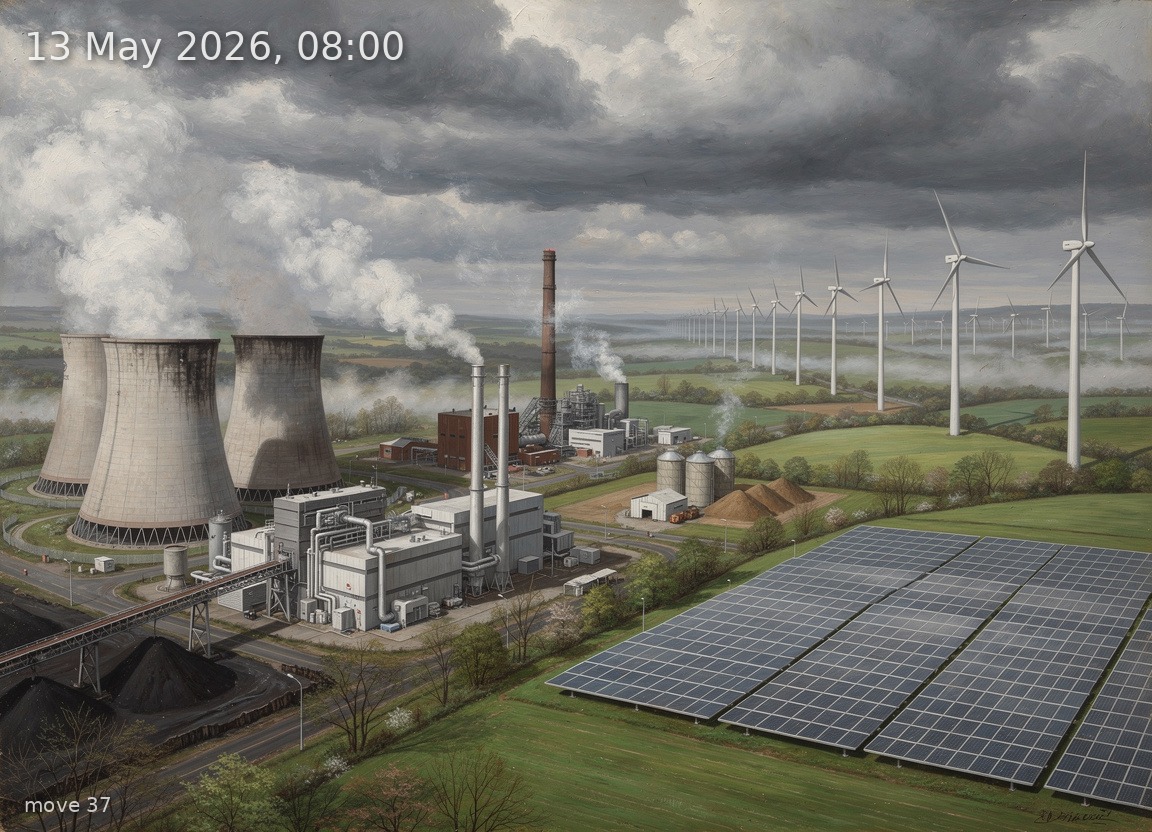
Overcast skies limit solar output; wind and coal carry the grid while 6.4 GW of net imports fill the gap.
Back
Generation mix
Wind onshore 27%
Wind offshore 2%
Solar 26%
Biomass 8%
Hydro 3%
Natural gas 11%
Hard coal 9%
Brown coal 14%
66%
Renewable share
15.3 GW
Wind (on + offshore)
13.6 GW
Solar
52.9 GW
Total generation
-6.4 GW
Net import
126.7 €/MWh
Day-ahead price
7.1°C / 8 km/h
Temp / Wind speed
Open-Meteo, Kassel (51.3°N 9.5°E)
100% / 4.0 W/m²
Cloud cover / Radiation
235
gCO₂/kWh
Image prompt
Wind onshore 14.2 GW dominates the right third of the scene as dozens of tall three-blade turbines with white tubular towers and grey nacelles, their rotors turning gently in light wind, receding across rolling green spring fields into the hazy distance. Brown coal 7.4 GW occupies the left foreground as a cluster of massive hyperbolic cooling towers emitting thick white-grey steam plumes that merge into the overcast sky, with conveyor belts carrying dark lignite visible at the base. Natural gas 6.0 GW appears centre-left as a compact CCGT plant with twin slender exhaust stacks releasing thin heat shimmer. Hard coal 4.5 GW stands behind the gas plant as a smaller conventional power station with a single large smokestack and coal bunkers. Solar 13.6 GW is represented in the centre-right as vast fields of aluminium-framed crystalline silicon panels stretching across flat farmland, their surfaces reflecting only dull grey light — no sunshine, no glint, purely diffuse illumination under total overcast. Biomass 4.4 GW appears as a mid-sized industrial facility with wood-chip silos and a modest stack with pale exhaust, nestled between the coal complex and the solar fields. Hydro 1.7 GW is a small run-of-river station barely visible in the middle distance along a grey river. Wind offshore 1.1 GW is suggested by a faint line of turbines on the far horizon. The sky is entirely covered by a thick, oppressive blanket of low stratus clouds in tones of slate grey and pewter — no blue, no sun, no breaks — pressing down heavily on the landscape, evoking high electricity prices. The lighting is flat daytime at 08:00 in May: diffuse, shadowless, cool-toned. Temperature is 7°C: spring vegetation is fresh green but restrained, trees not yet fully leafed, some bare branches. Light mist hangs in low valleys. The atmosphere is heavy, humid, industrial. Highly detailed oil painting in the tradition of 19th-century German Romantic landscape painters — Caspar David Friedrich meets industrial realism — with rich muted colour, visible impasto brushwork, atmospheric depth, and meticulous engineering accuracy on all energy infrastructure. No text, no labels.