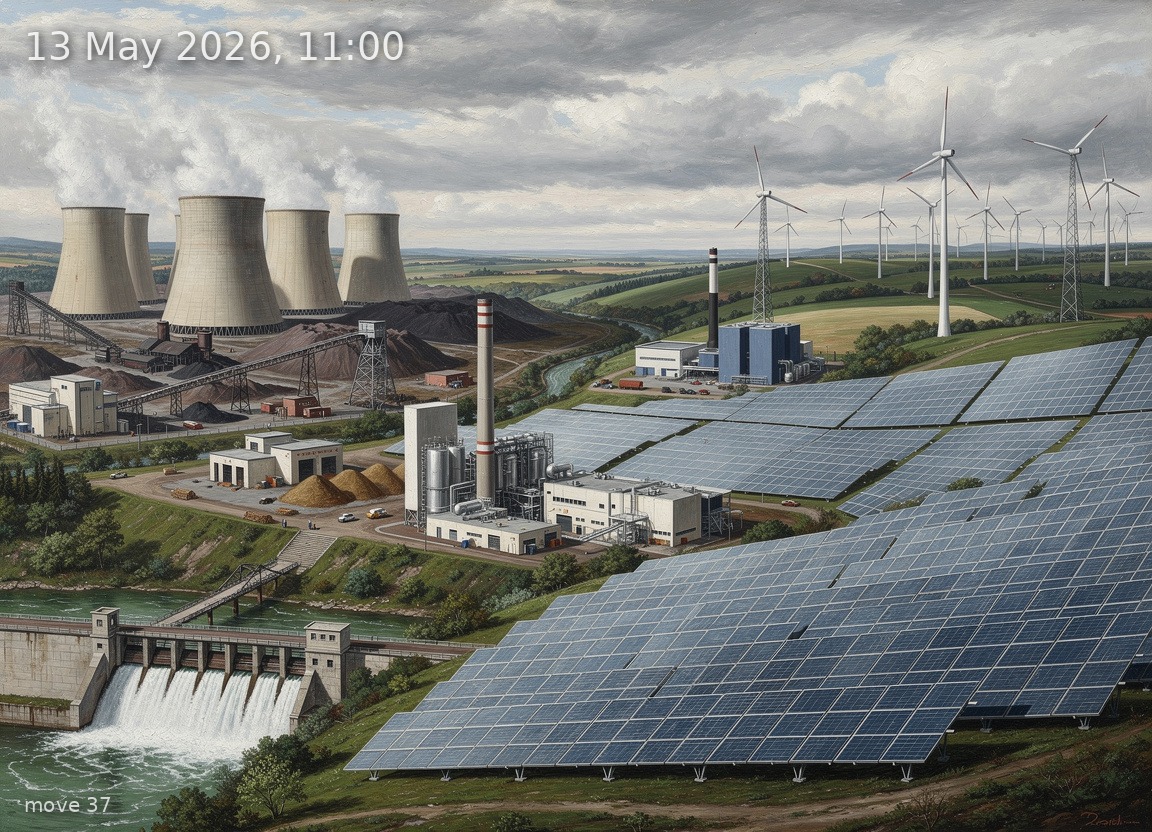
Solar (29.4 GW) and onshore wind (17.3 GW) dominate an overcast midday grid exporting 6.3 GW.
Back
Generation mix
Wind onshore 27%
Wind offshore 1%
Solar 45%
Biomass 6%
Hydro 2%
Natural gas 5%
Hard coal 5%
Brown coal 8%
81%
Renewable share
17.7 GW
Wind (on + offshore)
29.4 GW
Solar
64.9 GW
Total generation
+6.2 GW
Net export
83.8 €/MWh
Day-ahead price
10.6°C / 9 km/h
Temp / Wind speed
Open-Meteo, Kassel (51.3°N 9.5°E)
100% / 140.0 W/m²
Cloud cover / Radiation
132
gCO₂/kWh
Image prompt
Solar 29.4 GW dominates the centre and right of the composition as vast rolling fields of aluminium-framed crystalline silicon photovoltaic panels stretching to the horizon, covering nearly half the canvas; onshore wind 17.3 GW fills the upper-right quarter as dozens of tall three-blade turbines on lattice and tubular towers, rotors turning slowly in light breeze; brown coal 5.3 GW occupies the far left as a cluster of massive hyperbolic cooling towers emitting thick white steam plumes, with conveyor belts feeding lignite into boiler houses; biomass 4.1 GW appears left-centre as a modest industrial plant with a tall rectangular stack and woodchip storage silos; natural gas 3.5 GW sits beside the coal as two compact CCGT units with slender single exhaust stacks and heat-recovery steam generators; hard coal 3.4 GW is rendered as a traditional coal-fired station with a single large chimney and coal bunker; hydro 1.6 GW appears in the lower-left foreground as a concrete dam with spillway releasing white water into a green river valley; offshore wind 0.4 GW is barely visible as tiny turbines on the far horizon line. The sky is entirely overcast—a heavy, uniform blanket of grey-white stratus clouds at full 100% cover—but it is full midday daylight at 11:00 in May, so the scene is brightly and evenly lit with no shadows, a flat diffused luminosity. The atmosphere feels heavy and slightly oppressive, reflecting a moderately high electricity price. The landscape is spring in central Germany at 10.6°C: fresh pale-green deciduous trees beginning to leaf out, cool damp meadows, grass not yet lush. Painted in the style of a highly detailed 19th-century German Romantic oil painting—rich layered colour, visible impasto brushwork, atmospheric depth reminiscent of Caspar David Friedrich merged with industrial realism—with meticulous engineering accuracy on every turbine nacelle, every PV cell grid pattern, every cooling tower's parabolic profile. No text, no labels.