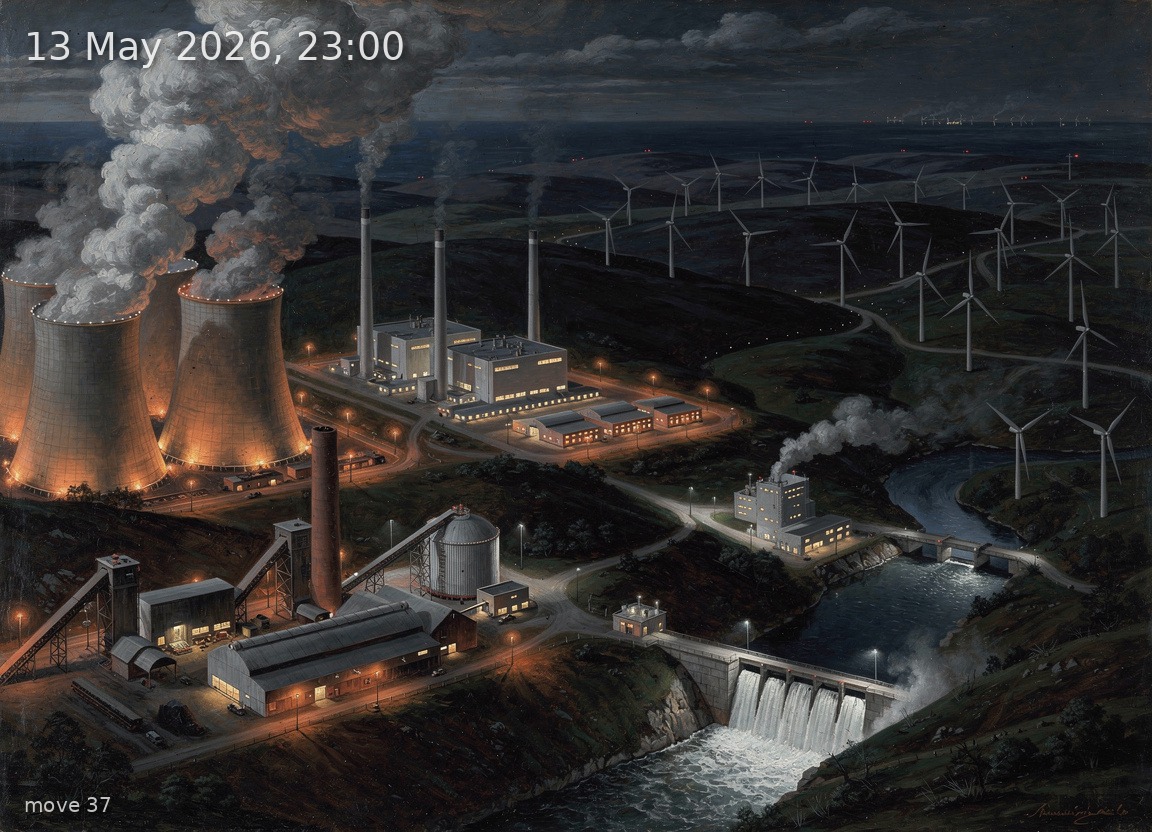
Onshore wind leads at 13.4 GW, but 6.3 GW net imports and heavy thermal dispatch drive prices above 123 EUR/MWh.
Back
Generation mix
Wind onshore 35%
Wind offshore 2%
Biomass 11%
Hydro 4%
Natural gas 16%
Hard coal 11%
Brown coal 20%
53%
Renewable share
14.2 GW
Wind (on + offshore)
0.0 GW
Solar
37.9 GW
Total generation
-6.4 GW
Net import
123.1 €/MWh
Day-ahead price
6.4°C / 11 km/h
Temp / Wind speed
Open-Meteo, Kassel (51.3°N 9.5°E)
88% / 0.0 W/m²
Cloud cover / Radiation
329
gCO₂/kWh
Image prompt
Wind onshore 13.4 GW dominates the right half of the scene as dozens of tall three-blade wind turbines with white lattice towers stretching across rolling dark hills, rotors turning in moderate wind; brown coal 7.6 GW occupies the far left as a cluster of massive hyperbolic cooling towers emitting thick white-grey steam plumes, lit from below by orange sodium lamps; natural gas 6.0 GW appears left-of-centre as a pair of compact CCGT power stations with tall slender exhaust stacks venting thin heat shimmer; hard coal 4.3 GW sits beside the gas plants as a blocky industrial complex with a single large chimney and conveyor belts leading to coal bunkers; biomass 4.3 GW is rendered as a mid-ground wood-fired power plant with a rounded silo and low stack emitting pale smoke; hydro 1.5 GW appears as a small concrete dam with spillway in a valley in the centre-right middle distance; wind offshore 0.8 GW is barely visible on the far horizon as a few tiny turbines on a dark sea line. The sky is completely dark, deep navy-black, 88% cloud cover obscuring any stars, no twilight whatsoever — it is 23:00 in May. All structures are illuminated solely by artificial light: warm sodium-orange industrial floodlights, red aviation warning lights blinking atop turbine nacelles and smokestacks, and a few scattered glowing windows in control buildings. The atmosphere feels heavy and oppressive, reflecting the high electricity price — low dense clouds press down on the scene, faintly catching the orange-amber industrial glow from below. Spring vegetation is present but barely visible in the darkness: fresh green grass and leafing trees suggested by dim reflected light. Temperature is cool at 6.4°C, hinted by a slight mist hovering near the ground between the turbines. Painted in the style of a highly detailed 19th-century German Romantic oil painting — rich, dark palette of deep blues, warm ambers, and cool greys, visible impasto brushwork, atmospheric depth with layers of industrial haze receding into blackness, meticulous engineering accuracy in every nacelle, cooling tower curve, and exhaust stack joint. No text, no labels.