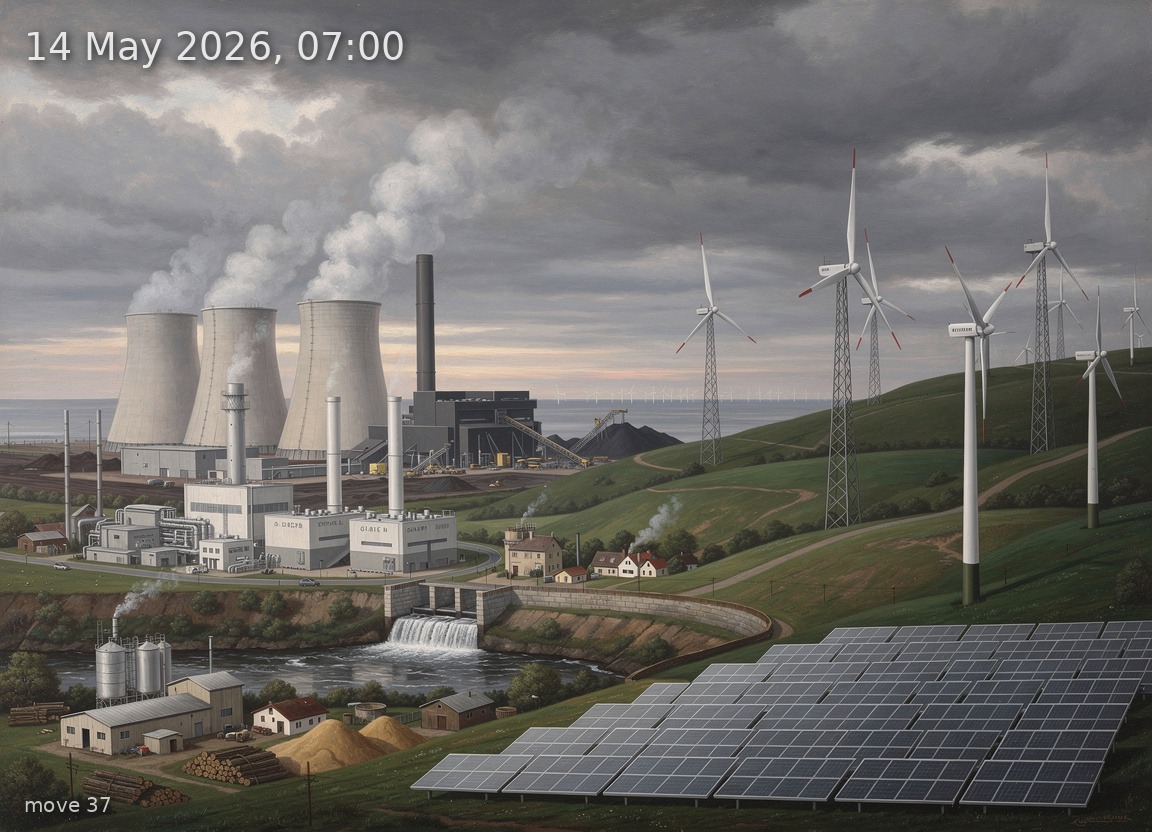
Onshore wind leads at 13.3 GW; overcast skies limit solar, keeping brown coal and gas firmly dispatched.
Back
Generation mix
Wind onshore 31%
Wind offshore 5%
Solar 16%
Biomass 10%
Hydro 3%
Natural gas 12%
Hard coal 9%
Brown coal 14%
65%
Renewable share
15.2 GW
Wind (on + offshore)
7.0 GW
Solar
42.9 GW
Total generation
+2.0 GW
Net export
108.1 €/MWh
Day-ahead price
6.3°C / 8 km/h
Temp / Wind speed
Open-Meteo, Kassel (51.3°N 9.5°E)
100% / 2.0 W/m²
Cloud cover / Radiation
240
gCO₂/kWh
Image prompt
Wind onshore 13.3 GW dominates the right half of the scene as dozens of tall three-blade turbines on lattice and tubular towers stretching across rolling green hills; brown coal 6.1 GW occupies the left quarter as a massive lignite power station with three hyperbolic cooling towers trailing thick white steam plumes; natural gas 5.2 GW appears centre-left as a pair of compact CCGT plants with slim exhaust stacks venting thin vapour; hard coal 3.7 GW sits behind the gas plant as a block-shaped station with a single tall chimney and coal conveyors; solar 7.0 GW fills the centre-right foreground as broad fields of aluminium-framed crystalline silicon panels reflecting only flat grey light under heavy cloud; biomass 4.4 GW appears as a cluster of wood-chip-fed CHP facilities with modest stacks and log piles near the village edge; wind offshore 1.9 GW is visible as a distant line of turbines on the far horizon over a grey North Sea sliver; hydro 1.4 GW is a small run-of-river weir with a low concrete dam on a stream in the middle distance. TIME AND ATMOSPHERE: early dawn at 07:00 in May—the sky is a uniform ceiling of dense, heavy, low stratus clouds in tones of slate grey and dull pewter, no direct sunlight, only a diffuse pale luminosity at the eastern horizon suggesting sunrise hidden behind total overcast. The air feels cold at 6 °C; fresh green spring foliage on birch and beech trees is muted under the oppressive grey light. A light breeze stirs the grass but the turbines' blades rotate at moderate speed. The high electricity price is evoked by a dense, weighty, almost suffocating atmosphere pressing down on the landscape. Painted in the style of a highly detailed 19th-century German Romantic oil painting—rich, layered colour in muted earth tones and greys, visible impasto brushwork, atmospheric depth with haze softening distant elements, meticulous engineering detail on every turbine nacelle, every cooling tower flute, every PV panel frame—evoking Caspar David Friedrich's brooding skies meeting industrial realism. No text, no labels, no people in the foreground.