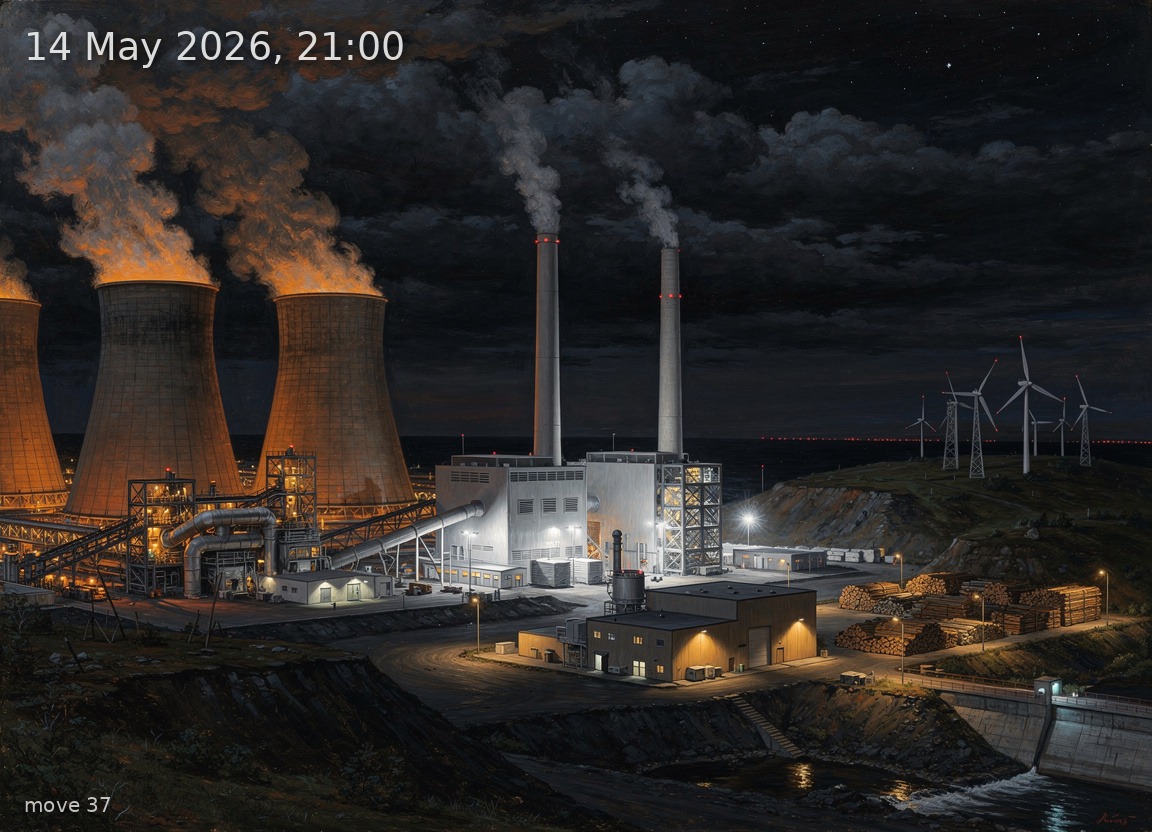
Brown coal, gas, and hard coal anchor a 28.9 GW domestic supply requiring 18.1 GW net imports at nightfall.
Back
Generation mix
Wind onshore 10%
Wind offshore 9%
Solar 0%
Biomass 15%
Hydro 5%
Natural gas 21%
Hard coal 14%
Brown coal 25%
39%
Renewable share
5.4 GW
Wind (on + offshore)
0.0 GW
Solar
28.9 GW
Total generation
-18.1 GW
Net import
152.2 €/MWh
Day-ahead price
8.7°C / 3 km/h
Temp / Wind speed
Open-Meteo, Kassel (51.3°N 9.5°E)
62% / 5.0 W/m²
Cloud cover / Radiation
419
gCO₂/kWh
Image prompt
Brown coal 7.4 GW dominates the left quarter of the scene as a massive lignite power station with three hyperbolic cooling towers emitting thick, billowing steam plumes lit from below by sodium-orange industrial lighting; natural gas 6.1 GW occupies the centre-left as two sleek CCGT units with tall single exhaust stacks venting thin white streams, their metallic facades catching amber floodlight glow; hard coal 4.1 GW appears centre-right as a traditional coal plant with a single large chimney and coal conveyors, illuminated by harsh white security lights; wind onshore 2.9 GW is represented by a small cluster of three-blade turbines on a distant ridge at the right, their rotors barely turning in the calm air, red aviation warning lights blinking; wind offshore 2.5 GW is suggested far right by faint red lights dotting the black horizon line over a dark sea; biomass 4.4 GW sits in the mid-ground right as a wood-fired CHP plant with a modest stack and warm-lit timber storage yard; hydro 1.5 GW is a small dam structure at the far right edge with a trickle of illuminated spillway water. The sky is completely dark—a deep navy-black canopy with no twilight, no sunset glow—overcast at 62% so only a few faint stars peek through gaps in cloud. The atmosphere feels heavy and oppressive, reflecting the high electricity price: thick low clouds press down, the air dense with industrial haze and steam. Spring vegetation—fresh green grass and budding deciduous trees—is barely visible in the peripheral glow of streetlights along a rural road in the foreground. The temperature reads cool; figures in the scene wear light jackets. The entire composition is rendered as a highly detailed oil painting in the tradition of 19th-century German Romantic landscape painters such as Caspar David Friedrich and Carl Blechen—rich, deep colour palette of blacks, deep blues, warm oranges, and industrial greys, with visible confident brushwork, atmospheric perspective, and chiaroscuro contrast between glowing industrial facilities and the surrounding darkness. Every technology is painted with meticulous engineering accuracy: lattice tower details on wind turbines, aluminium cladding on gas turbine housings, conveyor belt structures at the coal plant. No text, no labels.