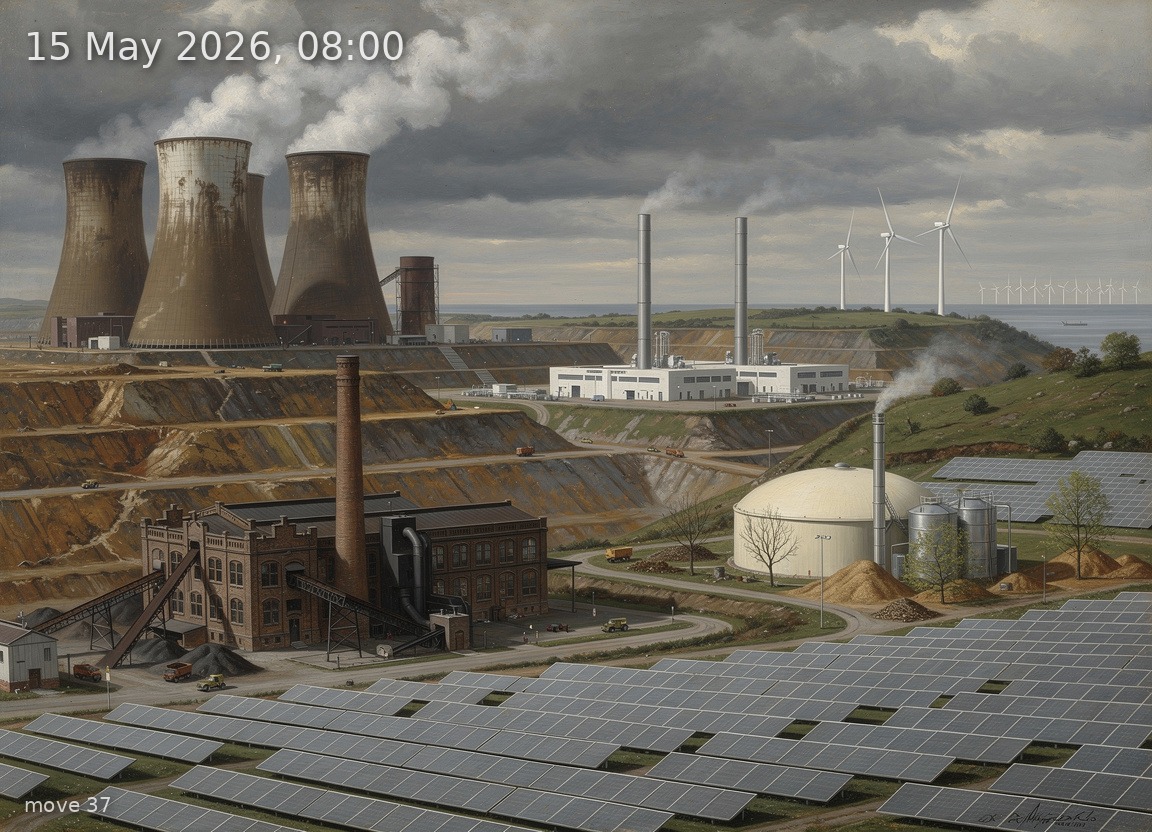
Overcast skies limit solar output; brown coal and gas fill a 25.9 GW residual load with 3.6 GW net imports.
Back
Generation mix
Wind onshore 7%
Wind offshore 7%
Solar 39%
Biomass 9%
Hydro 3%
Natural gas 12%
Hard coal 8%
Brown coal 15%
65%
Renewable share
6.7 GW
Wind (on + offshore)
18.3 GW
Solar
47.3 GW
Total generation
-3.6 GW
Net import
124.0 €/MWh
Day-ahead price
6.4°C / 2 km/h
Temp / Wind speed
Open-Meteo, Kassel (51.3°N 9.5°E)
96% / 6.0 W/m²
Cloud cover / Radiation
243
gCO₂/kWh
Image prompt
Brown coal 7.2 GW dominates the left quarter of the scene as a cluster of massive hyperbolic cooling towers with thick white-grey steam plumes merging into the overcast sky, set amid open-pit lignite terrain with exposed brown earth terraces. Natural gas 5.5 GW appears left of centre as two compact CCGT plants with tall slender exhaust stacks releasing thin heat shimmer. Hard coal 3.9 GW sits centre-left as a dark brick power station with a single large chimney and coal conveyors. Biomass 4.4 GW is rendered centre-right as a wood-chip-fed plant with a rounded storage dome and modest stack. Solar 18.3 GW spans the entire right third and middle distance as vast fields of aluminium-framed crystalline silicon PV panels stretching to the horizon, their surfaces dull grey reflecting only diffuse light under the heavy cloud layer—no direct sunshine, no glint. Wind onshore 3.2 GW appears as a sparse row of three-blade turbines on low hills in the far right background, blades nearly still. Wind offshore 3.5 GW is suggested by distant turbines visible on a grey sea strip at the far horizon. Hydro 1.4 GW is a small run-of-river weir with a low concrete dam beside a green riverbank in the foreground. The sky is a uniform 96% overcast blanket of heavy stratocumulus in grey and pewter tones, lit by diffuse morning daylight from the east at 08:00—no sun disc visible, flat shadowless illumination. The temperature is a cool 6.4°C: spring vegetation is fresh green but subdued, grass damp, bare branches on some late-leafing trees. The atmosphere feels heavy and oppressive, reflecting the 124 EUR/MWh price—thick humid air, low ceiling, industrial haze blending with cloud base. Style: highly detailed oil painting in the tradition of 19th-century German Romantic landscape painters such as Caspar David Friedrich and Carl Blechen, rich muted colour palette of greys, ochres, mossy greens, and slate blues, visible confident brushwork, atmospheric perspective with industrial haze fading into cloud, meticulous engineering detail on all infrastructure. No text, no labels.