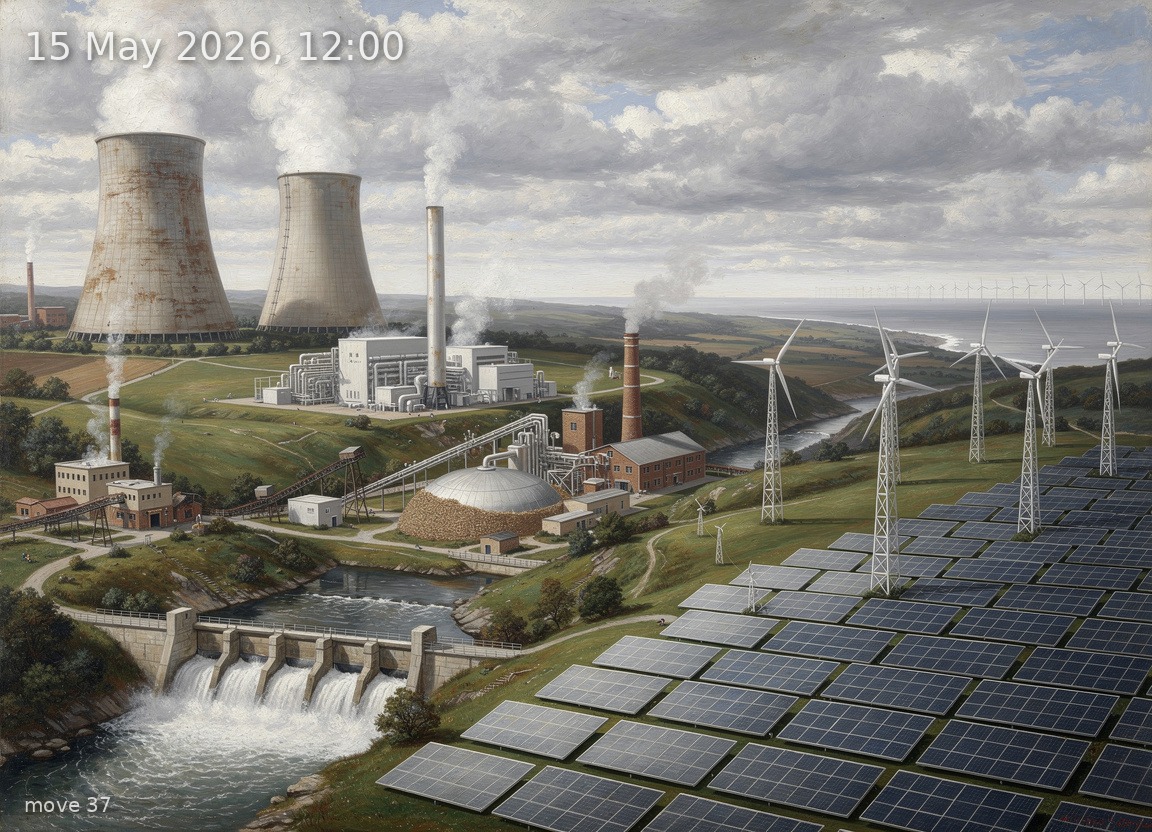
Solar at 35.8 GW leads an 88.7% renewable midday, driving 8.4 GW net exports with moderate pricing.
Back
Generation mix
Wind onshore 12%
Wind offshore 8%
Solar 60%
Biomass 6%
Hydro 2%
Natural gas 4%
Hard coal 2%
Brown coal 6%
89%
Renewable share
12.0 GW
Wind (on + offshore)
35.8 GW
Solar
59.8 GW
Total generation
+8.4 GW
Net export
54.3 €/MWh
Day-ahead price
10.6°C / 6 km/h
Temp / Wind speed
Open-Meteo, Kassel (51.3°N 9.5°E)
89% / 300.0 W/m²
Cloud cover / Radiation
80
gCO₂/kWh
Image prompt
Solar 35.8 GW dominates the right two-thirds of the canvas as vast rolling fields of aluminium-framed crystalline silicon PV panels stretching to the horizon, their blue-grey surfaces reflecting a diffuse milky light; wind onshore 7.2 GW appears as clusters of tall three-blade turbines with white lattice towers on low green hills in the centre-right, blades turning slowly in light breeze; wind offshore 4.8 GW is visible in the far distance as a line of larger turbines rising from a grey sea glimpsed through a gap in the terrain at the far right; brown coal 3.5 GW occupies the left background as a pair of massive hyperbolic cooling towers emitting thick white steam plumes that merge with the overcast sky; natural gas 2.1 GW sits centre-left as a compact modern CCGT plant with a single tall exhaust stack and thin heat shimmer; biomass 3.8 GW is rendered as a mid-sized industrial facility with a wood-chip storage dome and a squat brick chimney with faint grey smoke, positioned left of centre; hard coal 1.1 GW appears as a smaller traditional power station with a rectangular chimney near the far left edge; hydro 1.4 GW is depicted as a modest concrete dam with water cascading through spillways in the left foreground. The sky is heavily overcast at 89% cloud cover—a thick blanket of grey-white stratocumulus—but bright diffuse daylight at midday noon penetrates strongly, casting soft shadowless illumination across the entire landscape. The temperature is a cool 10.6 °C in mid-May: spring vegetation is vivid green but not yet lush, with fresh leaves on birch and linden trees and yellow rapeseed fields visible between solar arrays. The atmosphere is slightly heavy and hazy, suggesting a moderate price environment—neither oppressive nor clear. Painted in the style of a highly detailed 19th-century German Romantic oil painting with rich colour palette, visible impasto brushwork, and deep atmospheric perspective in the tradition of Caspar David Friedrich and Carl Blechen, but with meticulous engineering accuracy in every turbine nacelle, panel frame, cooling tower curve, and exhaust stack. No text, no labels, no people prominent—an industrial pastoral of enormous scale.