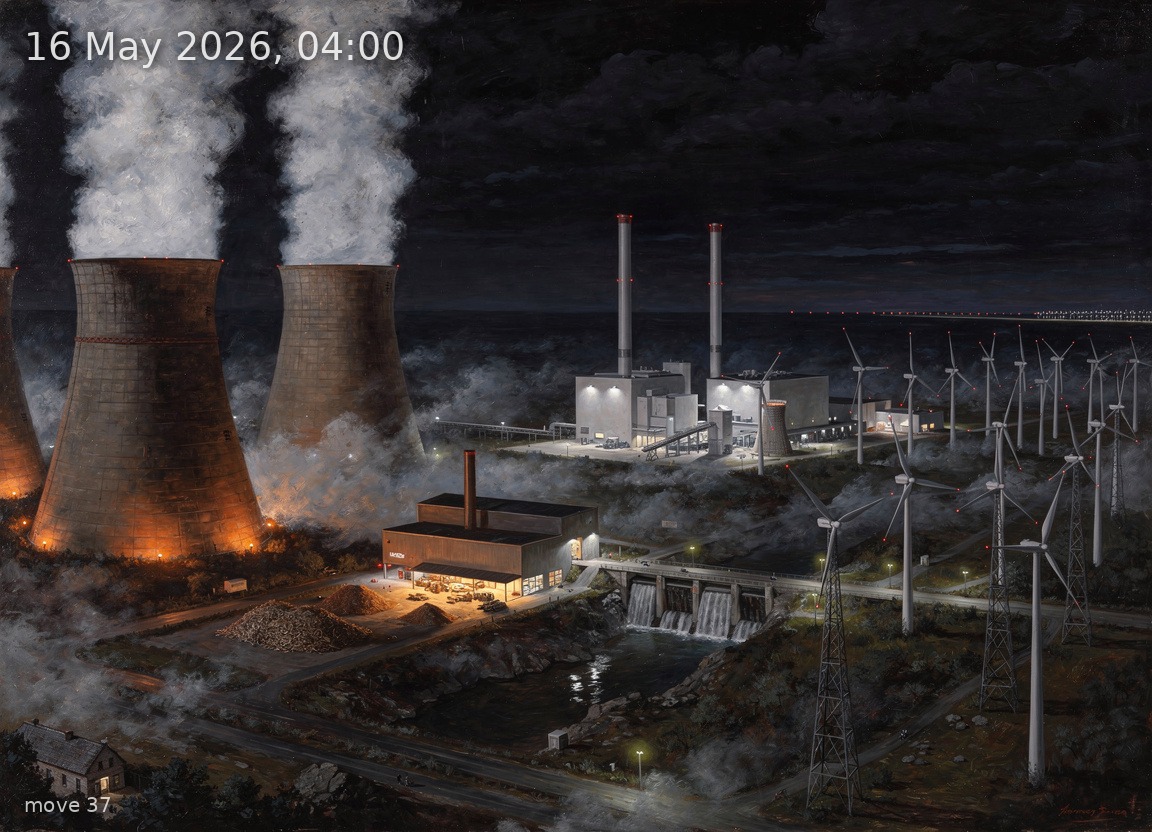
Wind and brown coal dominate overnight generation as zero solar and moderate demand keep gas and hard coal dispatched at elevated prices.
Back
Generation mix
Wind onshore 29%
Wind offshore 15%
Solar 0%
Biomass 10%
Hydro 3%
Natural gas 14%
Hard coal 9%
Brown coal 19%
58%
Renewable share
17.0 GW
Wind (on + offshore)
0.0 GW
Solar
38.8 GW
Total generation
+1.3 GW
Net export
114.0 €/MWh
Day-ahead price
6.4°C / 2 km/h
Temp / Wind speed
Open-Meteo, Kassel (51.3°N 9.5°E)
100% / 0.0 W/m²
Cloud cover / Radiation
295
gCO₂/kWh
Image prompt
Brown coal 7.4 GW occupies the left quarter as a cluster of massive hyperbolic cooling towers with thick white steam plumes rising into darkness, lit from below by orange sodium lamps; natural gas 5.5 GW appears just right of centre as two compact CCGT power blocks with tall single exhaust stacks emitting thin heat shimmer, illuminated by harsh industrial floodlights; hard coal 3.6 GW sits behind as a smaller conventional boiler house with a single squat cooling tower and a coal conveyor belt faintly visible; wind onshore 11.3 GW spans the entire right third and recedes into the far background as dozens of three-blade turbines on lattice and tubular towers, their red aviation warning lights blinking in staggered rhythm against the black sky; wind offshore 5.7 GW is suggested at the far right horizon as a distant line of turbine lights reflected on a dark strip of North Sea; biomass 4.0 GW appears as a modest wood-chip-fired plant with a low rectangular stack and a warm amber glow from its fuel yard; hydro 1.3 GW is a small dam structure in the middle distance with faint spillway illumination. The sky is completely black to deep navy, no twilight, no moon, 100% overcast so no stars, an oppressive heavy cloud ceiling barely visible where industrial light catches moisture. The temperature is a chilly 6°C; spring grass and budding deciduous trees are touched with dew, rendered in muted dark greens. The air is nearly still — turbine blades turn slowly. The overall atmosphere is heavy, brooding, and industrially lit, reflecting the high electricity price. Highly detailed oil painting in the tradition of 19th-century German Romantic landscape art — rich impasto brushwork, dramatic chiaroscuro between artificial light and enveloping darkness, atmospheric depth with fog and steam layering the middle ground, meticulous engineering accuracy on turbine nacelles, cooling tower geometry, and CCGT stack profiles. No text, no labels.