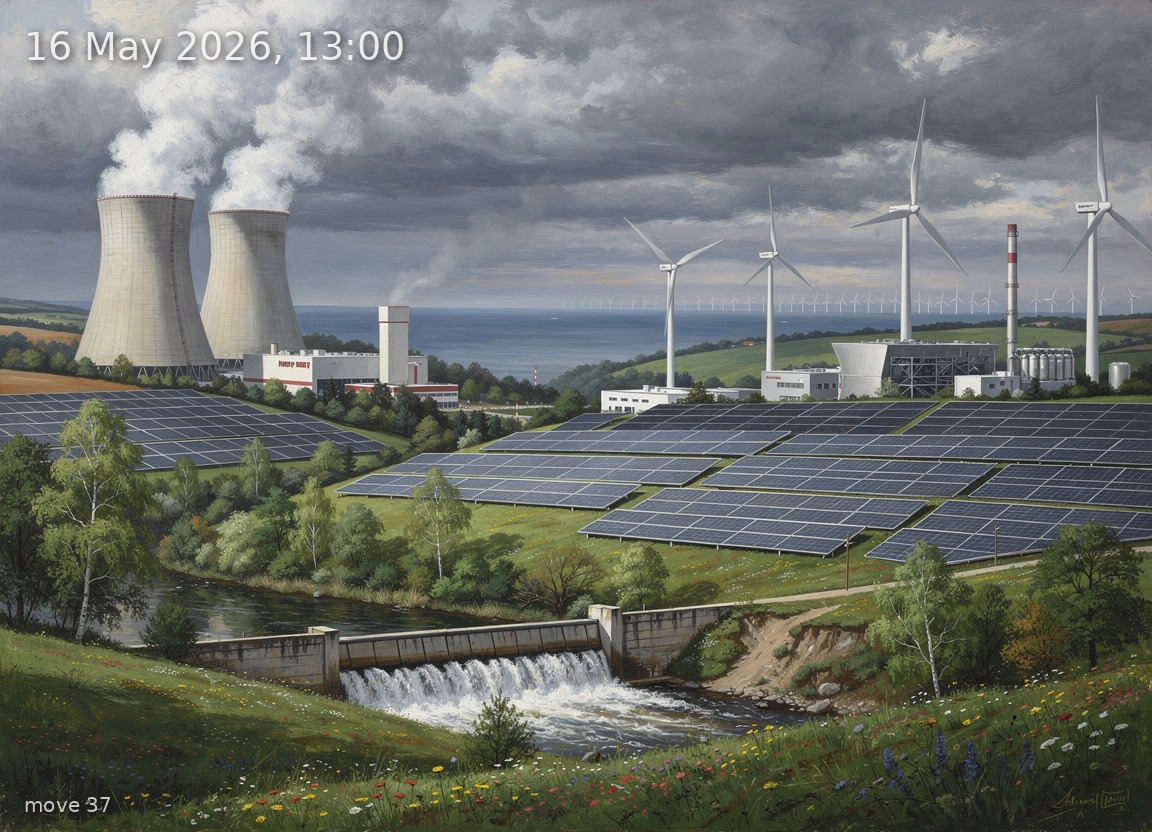
Solar (34.4 GW) and wind (19.9 GW) drive 91.7% renewable share, pushing prices negative amid ~19 GW net exports.
Back
Generation mix
Wind onshore 23%
Wind offshore 8%
Solar 53%
Biomass 6%
Hydro 2%
Natural gas 3%
Hard coal 1%
Brown coal 5%
92%
Renewable share
19.8 GW
Wind (on + offshore)
34.4 GW
Solar
65.1 GW
Total generation
+19.3 GW
Net export
-2.2 €/MWh
Day-ahead price
10.1°C / 6 km/h
Temp / Wind speed
Open-Meteo, Kassel (51.3°N 9.5°E)
88% / 49.0 W/m²
Cloud cover / Radiation
58
gCO₂/kWh
Image prompt
Solar 34.4 GW dominates the scene as vast fields of aluminium-framed crystalline silicon photovoltaic panels stretching across more than half the canvas, covering gentle rolling central German hills; wind onshore 15.0 GW appears as dozens of tall three-blade turbines with white tubular towers and nacelles scattered across ridgelines in the middle distance; wind offshore 4.9 GW is suggested by a row of turbines on the far horizon above a faint coastal haze; biomass 3.9 GW is rendered as a mid-sized wood-fired power station with a rectangular stack emitting thin pale smoke at the left-center; brown coal 3.1 GW occupies the far left as a pair of large hyperbolic cooling towers with heavy white steam plumes rising from a lignite plant; natural gas 1.8 GW sits as a compact CCGT facility with a single tall exhaust stack and modest heat shimmer beside the brown coal plant; hydro 1.5 GW appears as a concrete run-of-river weir with foaming spillway in the foreground valley; hard coal 0.5 GW is a single small stack barely visible behind the gas plant. The sky is heavily overcast at 88% cloud cover—a thick, soft, pewter-grey blanket of stratocumulus with diffuse milky light filtering through, no direct sun visible, yet the landscape is fully lit in the flat bright manner of a midday under deep overcast in May. Vegetation is lush mid-spring green, fresh beech and birch leaves, wildflowers in meadow margins, temperature around 10°C giving a cool crispness—no heat haze. The air feels calm, turbines turning slowly in the light 5.9 km/h breeze. The atmosphere is serene and expansive, reflecting the negative electricity price—open sky feeling, no oppression. Highly detailed oil painting in the tradition of 19th-century German Romantic landscape painters such as Caspar David Friedrich and Carl Blechen: rich layered colour, visible confident brushwork, atmospheric aerial perspective with misty depth toward the horizon, dramatic scale contrasting human industry against the vast overcast sky. Every technology is rendered with meticulous engineering accuracy—turbine blade profiles, PV cell grid patterns, cooling tower parabolic geometry, CCGT heat-recovery housings. The composition feels like a discovered masterwork of the industrial pastoral, luminous despite the grey. No text, no labels, no people in the foreground.