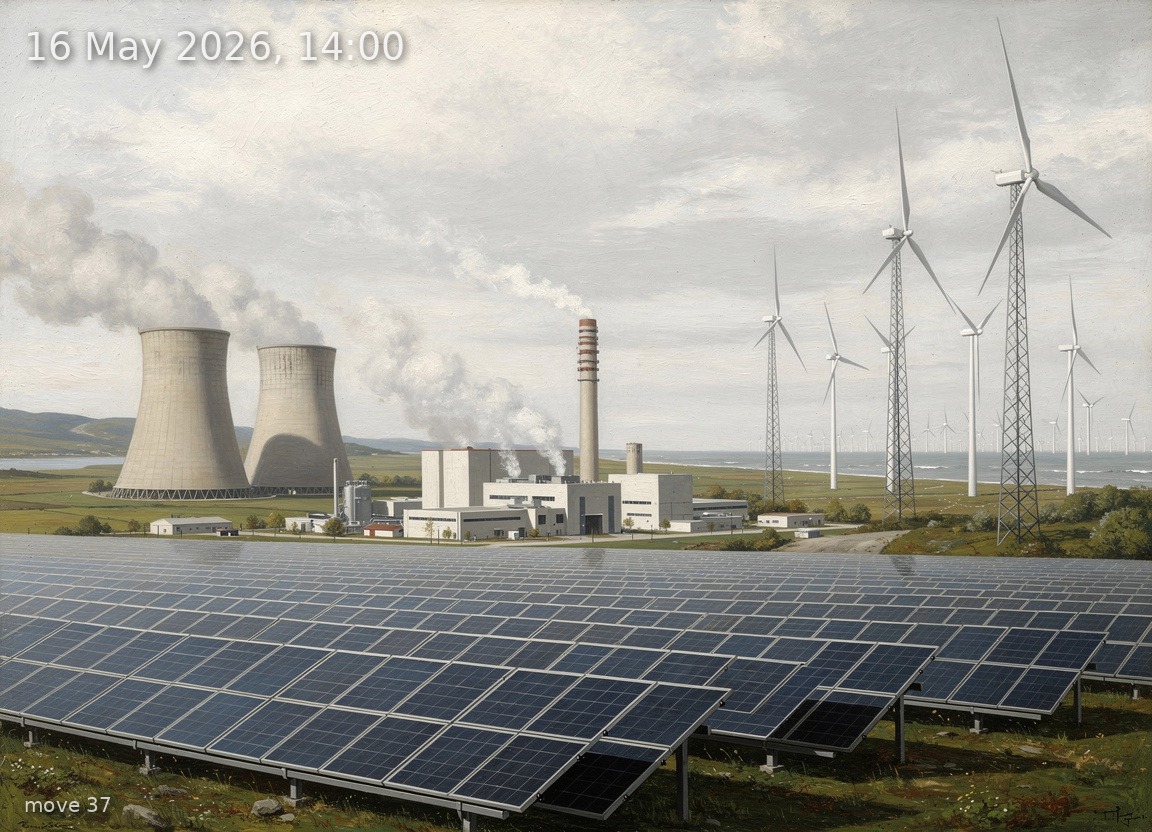
Solar at 33 GW and wind at 20 GW drive 18.7 GW net exports and a slightly negative price.
Back
Generation mix
Wind onshore 23%
Wind offshore 8%
Solar 52%
Biomass 6%
Hydro 2%
Natural gas 3%
Hard coal 1%
Brown coal 5%
92%
Renewable share
19.8 GW
Wind (on + offshore)
33.1 GW
Solar
63.6 GW
Total generation
+18.7 GW
Net export
-1.9 €/MWh
Day-ahead price
10.9°C / 1 km/h
Temp / Wind speed
Open-Meteo, Kassel (51.3°N 9.5°E)
100% / 232.0 W/m²
Cloud cover / Radiation
59
gCO₂/kWh
Image prompt
Solar 33.1 GW dominates the scene as a vast foreground plain of aluminium-framed crystalline silicon photovoltaic panels stretching to the mid-ground, catching diffused midday light under a luminous white-grey overcast sky. Wind onshore 14.9 GW fills the right third of the composition as dozens of tall three-blade turbines on lattice and tubular towers receding into atmospheric haze, blades barely turning in near-calm air. Wind offshore 4.9 GW appears at the far right horizon as a line of turbines rising from a faintly visible grey sea. Biomass 3.9 GW is rendered as a cluster of modest industrial buildings with short stacks emitting thin white steam, positioned left of centre behind the solar field. Brown coal 3.0 GW occupies the far left as two hyperbolic concrete cooling towers releasing thick pale steam plumes, proportionally smaller than the renewable elements. Natural gas 1.8 GW appears as a compact combined-cycle gas turbine plant with a single tall exhaust stack and thin heat shimmer, tucked between the lignite towers and biomass facility. Hydro 1.5 GW is suggested by a small reservoir dam visible in a valley in the distant left background. Hard coal 0.5 GW is a single small stack with a wisp of darker smoke near the lignite towers. The sky is fully overcast yet bright and pearlescent—full midday daylight diffused through thin alto-stratus—casting soft, almost shadowless illumination across the entire landscape. Spring vegetation: fresh pale-green fields, budding deciduous trees, cool 11 °C air suggested by figures in light jackets near a substation. The atmosphere is calm and open, reflecting the negative electricity price—no oppressive mood, simply an immense quiet abundance. Highly detailed oil painting in the tradition of 19th-century German Romantic landscape art—rich layered colour, visible impasto brushwork, meticulous atmospheric perspective—but every turbine nacelle, every PV cell grid line, every cooling tower flute is rendered with precise engineering accuracy. No text, no labels.