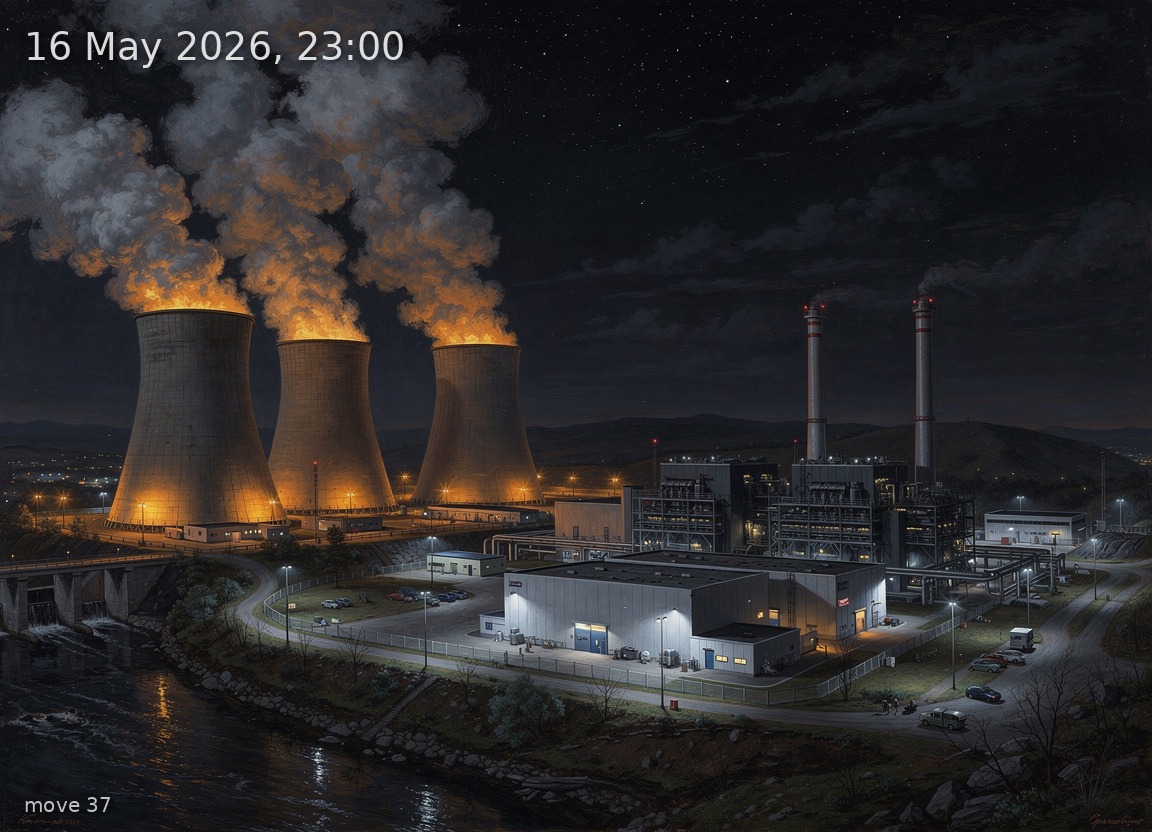
Brown coal, wind, and gas anchor nighttime generation while 10 GW of net imports cover remaining demand.
Back
Generation mix
Wind onshore 28%
Wind offshore 6%
Biomass 13%
Hydro 4%
Natural gas 17%
Hard coal 10%
Brown coal 22%
52%
Renewable share
10.8 GW
Wind (on + offshore)
0.0 GW
Solar
31.8 GW
Total generation
-10.0 GW
Net import
127.7 €/MWh
Day-ahead price
5.9°C / 5 km/h
Temp / Wind speed
Open-Meteo, Kassel (51.3°N 9.5°E)
10% / 0.0 W/m²
Cloud cover / Radiation
335
gCO₂/kWh
Image prompt
Brown coal 6.9 GW dominates the left quarter as a massive lignite power station with three hyperbolic cooling towers emitting thick white steam plumes lit from below by orange sodium lamps; natural gas 5.3 GW occupies the centre-left as two compact CCGT units with tall single exhaust stacks venting thin heat shimmer; hard coal 3.2 GW appears centre as a dark coal-fired plant with a single large chimney and conveyor belts; biomass 4.3 GW is rendered centre-right as a cluster of industrial biogas facilities with cylindrical digesters and small stacks with faint vapour; wind onshore 8.9 GW spans the right third as a long row of tall three-blade turbines on lattice towers turning slowly; wind offshore 1.9 GW appears in the far-right distance as a handful of turbines silhouetted on a dark horizon suggesting the sea; hydro 1.4 GW is a small dam structure with glowing facility lights at the far left edge. The scene is set at 23:00 on a May night — the sky is completely dark, deep navy-black, nearly clear with only 10% wispy cloud letting stars show through. Temperature is a cool 5.9°C; spring vegetation is present but muted in darkness — fresh green grass and budding trees visible only where industrial lighting reaches. Light wind barely stirs the landscape. The atmosphere is heavy and oppressive, reflecting the high electricity price — a brooding industrial stillness. All structures are lit only by artificial light: sodium-orange streetlights, blue-white facility floodlights, red aviation warning lights atop turbines and stacks. Rendered as a highly detailed oil painting in the tradition of 19th-century German Romantic landscape painters such as Caspar David Friedrich, with rich dark colour palette, visible impasto brushwork, atmospheric depth and chiaroscuro contrast between the glowing industrial installations and the vast dark sky. Every technology rendered with meticulous engineering accuracy: three-blade rotors with nacelles, hyperbolic concrete cooling tower profiles, aluminium-clad gas turbine housings. No text, no labels.