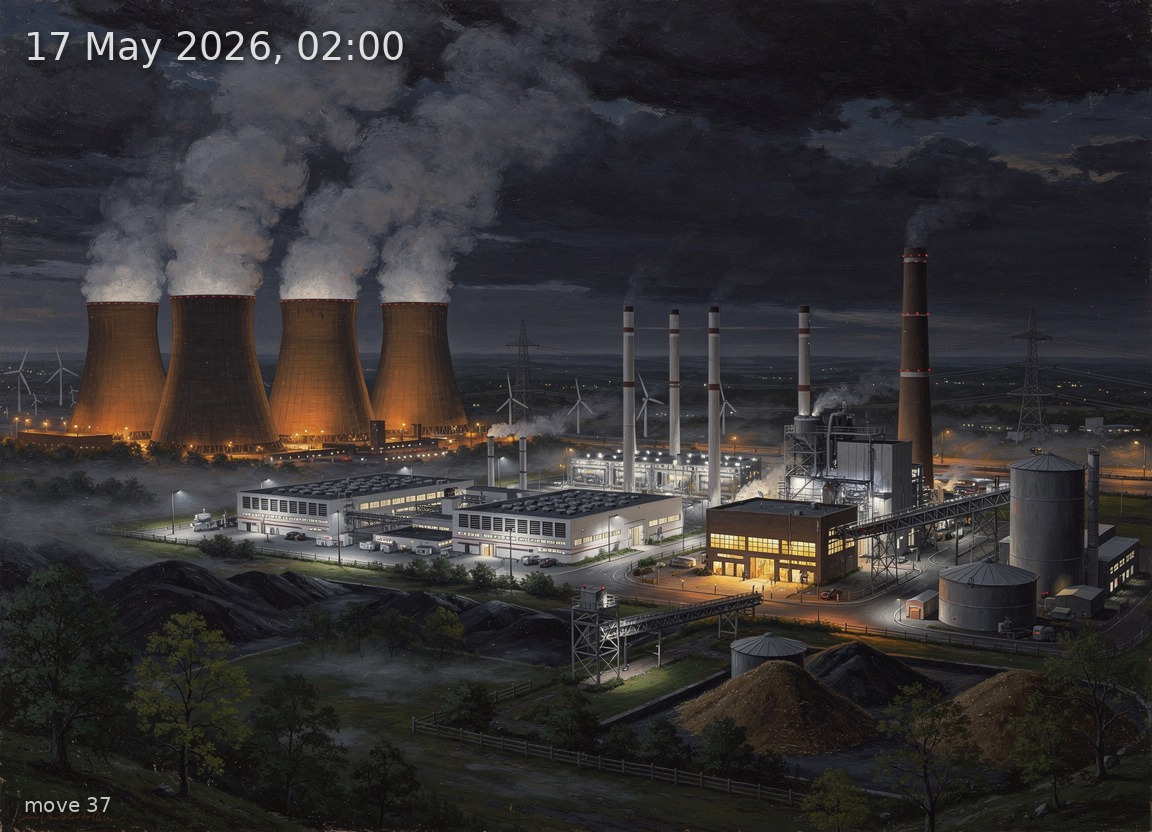
Wind and brown coal anchor overnight generation as 6.6 GW of net imports cover remaining German demand.
Back
Generation mix
Wind onshore 30%
Wind offshore 7%
Biomass 13%
Hydro 4%
Natural gas 15%
Hard coal 10%
Brown coal 20%
54%
Renewable share
11.3 GW
Wind (on + offshore)
0.0 GW
Solar
30.9 GW
Total generation
-6.5 GW
Net import
115.6 €/MWh
Day-ahead price
5.8°C / 2 km/h
Temp / Wind speed
Open-Meteo, Kassel (51.3°N 9.5°E)
94% / 0.0 W/m²
Cloud cover / Radiation
320
gCO₂/kWh
Image prompt
Wind onshore 9.1 GW dominates the right third of the scene as dozens of tall three-blade turbines on lattice towers stretching across dark rolling farmland; wind offshore 2.2 GW appears as a distant row of turbines on a barely visible sea horizon at far right. Brown coal 6.3 GW fills the left quarter as massive hyperbolic cooling towers emitting thick white steam plumes, lit from below by amber sodium lamps of an industrial complex. Natural gas 4.8 GW occupies the left-centre as a cluster of compact CCGT plants with slender exhaust stacks venting thin heat shimmer, illuminated by facility lighting. Hard coal 3.1 GW sits adjacent as a smaller power station with a single wide chimney and coal conveyor gantries under floodlights. Biomass 4.1 GW appears centre-right as a wood-chip fed CHP plant with a modest stack and warm-lit storage silos. Hydro 1.3 GW is a small dam structure in a mid-ground valley, water gleaming faintly under industrial glow. Time is 02:00 at night: the sky is completely black with a dense 94% overcast—no stars, no moon, no twilight glow whatsoever, only a deep charcoal-navy ceiling pressing down oppressively. Temperature is a cool 5.8°C in mid-May: fresh green foliage on trees barely visible in shadow, slight mist hanging at ground level. The atmosphere feels heavy and costly—thick humid air, low visibility, an industrial tension. Sodium-orange and white LED facility lights create isolated pools of warm and cold illumination against the surrounding darkness. Transmission pylons with high-voltage lines recede into the murk, suggesting cross-border power flows. Highly detailed oil painting in the tradition of 19th-century German Romantic landscape art—rich impasto brushwork, dramatic chiaroscuro between artificial light and enveloping darkness, atmospheric depth rendered through layered mist and smoke, meticulous engineering accuracy on every turbine nacelle, cooling tower, and exhaust stack. No text, no labels.