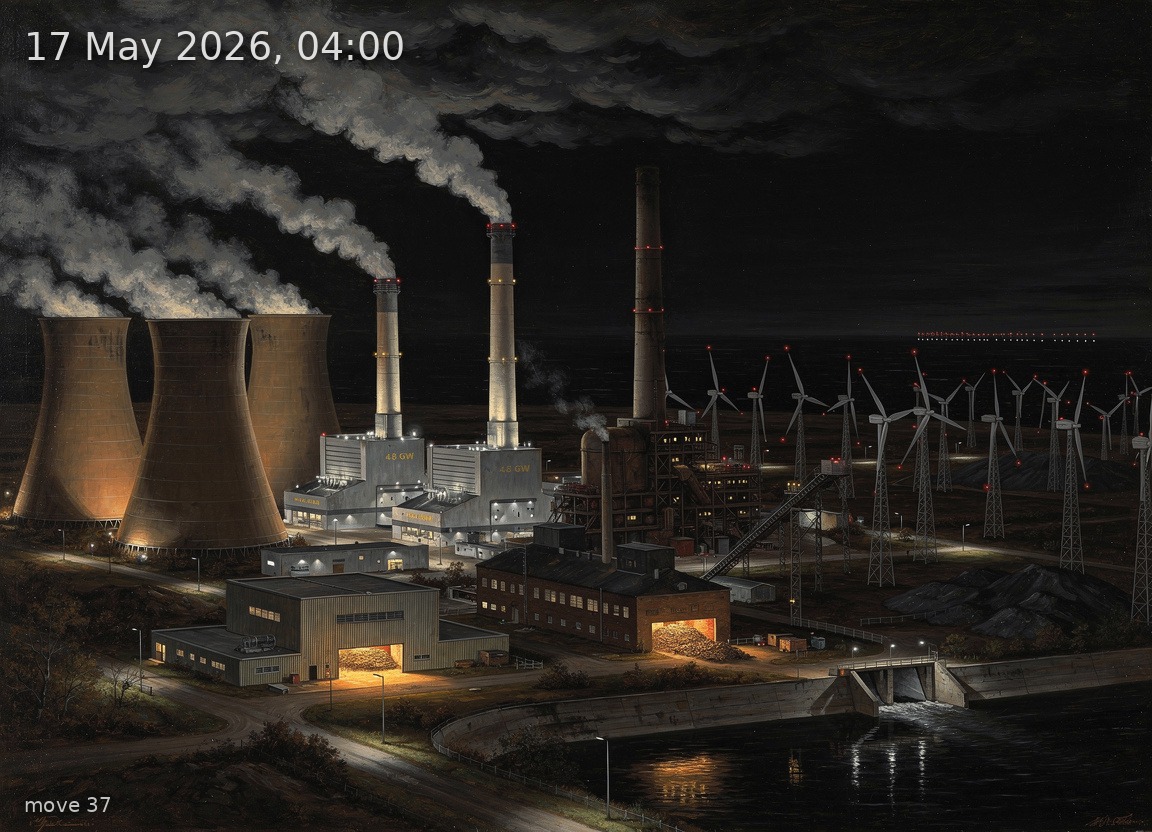
Coal and gas dominate nocturnal generation as wind provides moderate support and 7.4 GW net imports bridge the gap.
Back
Generation mix
Wind onshore 27%
Wind offshore 7%
Solar 0%
Biomass 14%
Hydro 4%
Natural gas 16%
Hard coal 10%
Brown coal 21%
52%
Renewable share
10.1 GW
Wind (on + offshore)
0.0 GW
Solar
29.8 GW
Total generation
-7.5 GW
Net import
109.2 €/MWh
Day-ahead price
6.0°C / 3 km/h
Temp / Wind speed
Open-Meteo, Kassel (51.3°N 9.5°E)
83% / 0.0 W/m²
Cloud cover / Radiation
331
gCO₂/kWh
Image prompt
Brown coal 6.3 GW dominates the left third of the scene as a massive lignite power station with four hyperbolic cooling towers emitting thick white steam plumes into the night sky; natural gas 4.8 GW fills the centre-left as two compact CCGT units with tall slender exhaust stacks venting heat shimmer; hard coal 3.1 GW appears centre-right as a darker, older coal plant with a single large smokestack and conveyor belts; wind onshore 8.1 GW spans the right third and extends into the background as dozens of three-blade turbines on lattice towers, their red aviation warning lights blinking in the darkness; wind offshore 2.0 GW is suggested on the far-right horizon as a faint cluster of distant turbine lights over a dark implied sea; biomass 4.1 GW appears as a modest wood-chip-fired plant with a glowing furnace visible through open doors near centre; hydro 1.3 GW is a small dam structure in the lower-right foreground with water gleaming faintly under artificial light. Time is 04:00 — completely dark, black sky with no twilight or sky glow, heavy 83% cloud cover obscuring all stars, the only illumination coming from sodium-orange streetlights along an access road, the amber and white industrial lighting of the power stations, and the red blinking nacelle lights of the wind turbines. The atmosphere is oppressive and heavy, reflecting a high electricity price — low clouds trap the steam and light pollution in a sullen brownish-orange haze above the industrial complex. Temperature is 6°C in mid-May: fresh green spring foliage on scattered birch trees in the foreground, damp with dew, barely visible in the artificial light. Light ground mist drifts across flat northern German terrain. Rendered as a highly detailed oil painting in the tradition of 19th-century German Romantic landscape painting — rich impasto brushwork, deep chiaroscuro contrasts between the glowing industrial facilities and the engulfing darkness, atmospheric depth receding into haze, meticulous engineering detail on every turbine nacelle, cooling tower, and smokestack, evoking the sublime tension between nature and industry. No text, no labels.