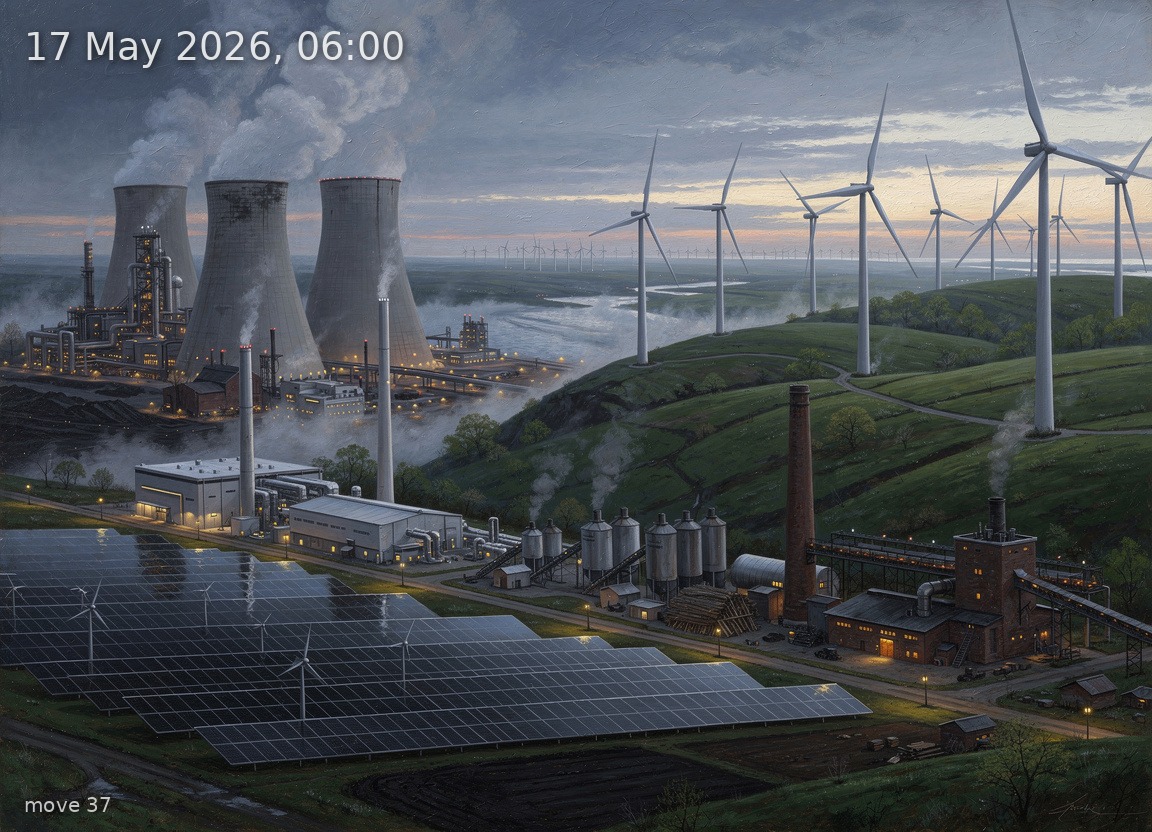
Wind and brown coal anchor pre-dawn generation as Germany imports 5.5 GW amid elevated prices.
Back
Generation mix
Wind onshore 25%
Wind offshore 8%
Solar 12%
Biomass 13%
Hydro 4%
Natural gas 14%
Hard coal 6%
Brown coal 19%
61%
Renewable share
10.6 GW
Wind (on + offshore)
3.8 GW
Solar
32.8 GW
Total generation
-5.5 GW
Net import
98.8 €/MWh
Day-ahead price
5.5°C / 5 km/h
Temp / Wind speed
Open-Meteo, Kassel (51.3°N 9.5°E)
14% / 0.0 W/m²
Cloud cover / Radiation
268
gCO₂/kWh
Image prompt
Wind onshore 8.1 GW dominates the right third of the scene as dozens of tall three-blade turbines with white tubular towers stretching across rolling green spring hillsides, their rotors turning slowly in light wind; brown coal 6.1 GW occupies the left quarter as a massive lignite power station with three hyperbolic cooling towers emitting thick white steam plumes into the dim sky; natural gas 4.7 GW appears centre-left as a pair of compact CCGT plants with tall slender exhaust stacks and faint heat shimmer; biomass 4.4 GW is rendered centre-right as a cluster of industrial wood-fired facilities with squat chimneys trailing thin grey smoke; solar 3.8 GW is shown as a field of aluminium-framed crystalline silicon panels in the mid-ground, their surfaces dark and reflective but receiving no direct sunlight yet; wind offshore 2.5 GW is visible on the far horizon as a line of turbines rising from a faintly visible sea; hard coal 2.0 GW appears as a single coal plant with a tall brick stack near the brown coal complex; hydro 1.2 GW is a small dam and powerhouse nestled in a valley in the far right background. Time of day is early dawn at 06:00 in May — the sky is deep blue-grey with the faintest band of pale cold light along the eastern horizon, no direct sun, no warm tones yet, landscape illuminated by diffuse pre-dawn glow and the amber sodium lamps of the industrial facilities. Temperature is a chilly 5.5°C — fresh spring vegetation on hills with morning dew, bare patches of dark earth. The atmosphere feels heavy and oppressive despite the clear sky, reflecting the high electricity price: a brooding industrial weight hangs over the scene, low mist threading between cooling towers and turbine bases. Highly detailed oil painting in the tradition of Caspar David Friedrich and Carl Blechen — rich tonal depth, visible impasto brushwork, dramatic atmospheric perspective, Romantic sensibility applied to an industrial energy landscape with meticulous engineering accuracy on every turbine nacelle, cooling tower, PV frame, and smokestack. No text, no labels.