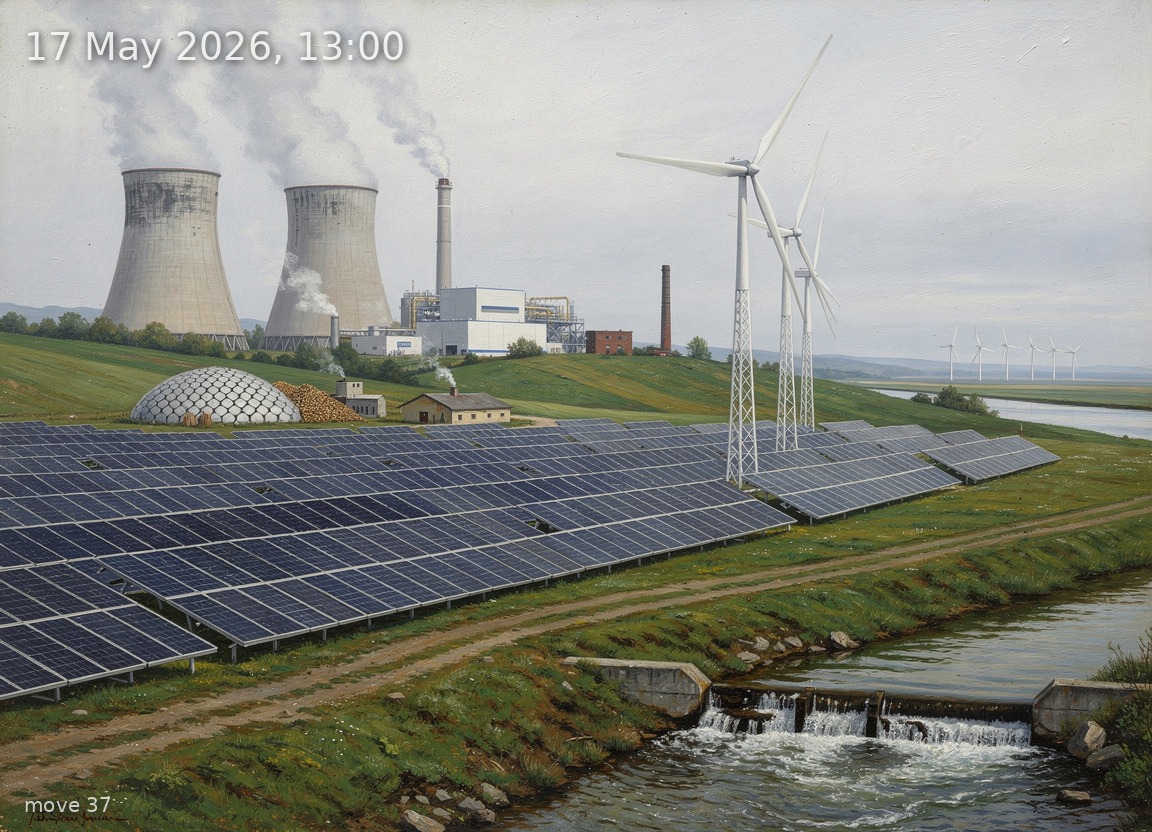
Solar at 36.2 GW drives a 15.8 GW net export and zero-price conditions under full overcast.
Back
Generation mix
Wind onshore 14%
Wind offshore 5%
Solar 63%
Biomass 7%
Hydro 2%
Natural gas 3%
Hard coal 1%
Brown coal 5%
91%
Renewable share
10.7 GW
Wind (on + offshore)
36.2 GW
Solar
57.4 GW
Total generation
+15.8 GW
Net export
0.0 €/MWh
Day-ahead price
13.8°C / 9 km/h
Temp / Wind speed
Open-Meteo, Kassel (51.3°N 9.5°E)
100% / 90.0 W/m²
Cloud cover / Radiation
65
gCO₂/kWh
Image prompt
Solar 36.2 GW dominates the scene as an immense field of aluminium-framed crystalline silicon photovoltaic panels stretching across the entire foreground and middle ground, covering roughly 63% of the visible landscape. Wind onshore 7.8 GW appears as a line of tall three-blade turbines with white lattice towers on gently rolling hills at right of centre, blades turning slowly. Wind offshore 2.9 GW is suggested by a distant cluster of turbines on the far horizon over a flat river plain. Biomass 3.9 GW occupies a modest compound at centre-left — a wood-chip storage dome and a small smokestack with thin white exhaust. Brown coal 3.0 GW sits in the left background as two hyperbolic concrete cooling towers releasing lazy steam plumes. Natural gas 1.9 GW appears as a compact CCGT plant with a single tall exhaust stack and minimal vapour, tucked behind the coal towers. Hydro 1.2 GW is depicted as a small concrete run-of-river weir on a stream cutting through the foreground. Hard coal 0.5 GW is a single dark brick stack barely visible behind the lignite towers, almost idle. Time is 1:00 PM in mid-May: full daylight but entirely overcast — a bright, uniform, white-grey sky with no visible sun, casting soft diffuse shadowless light across the landscape. The atmosphere feels calm and open, reflecting the zero electricity price. Spring vegetation: fresh bright-green grass, blooming rapeseed fields in vivid yellow patches between solar arrays, deciduous trees in new leaf. Temperature is mild at 13.8 °C — no heat haze, crisp air. Wind is light at 8.8 km/h, shown in slightly bent grass and gently spinning rotors. Style: highly detailed oil painting in the tradition of 19th-century German Romantic landscape painting — rich saturated colour, visible impasto brushwork, atmospheric aerial perspective with depth fading to soft blue-grey at the horizon — yet with meticulous technical accuracy for every piece of energy infrastructure: correct nacelle shapes, three-blade rotor geometry, aluminium PV frames, hyperbolic cooling tower curvature and reinforced concrete texture. The vastness of the solar field evokes the sublime scale favoured by Caspar David Friedrich, but the subject is the modern industrial energy landscape. No text, no labels, no human figures.