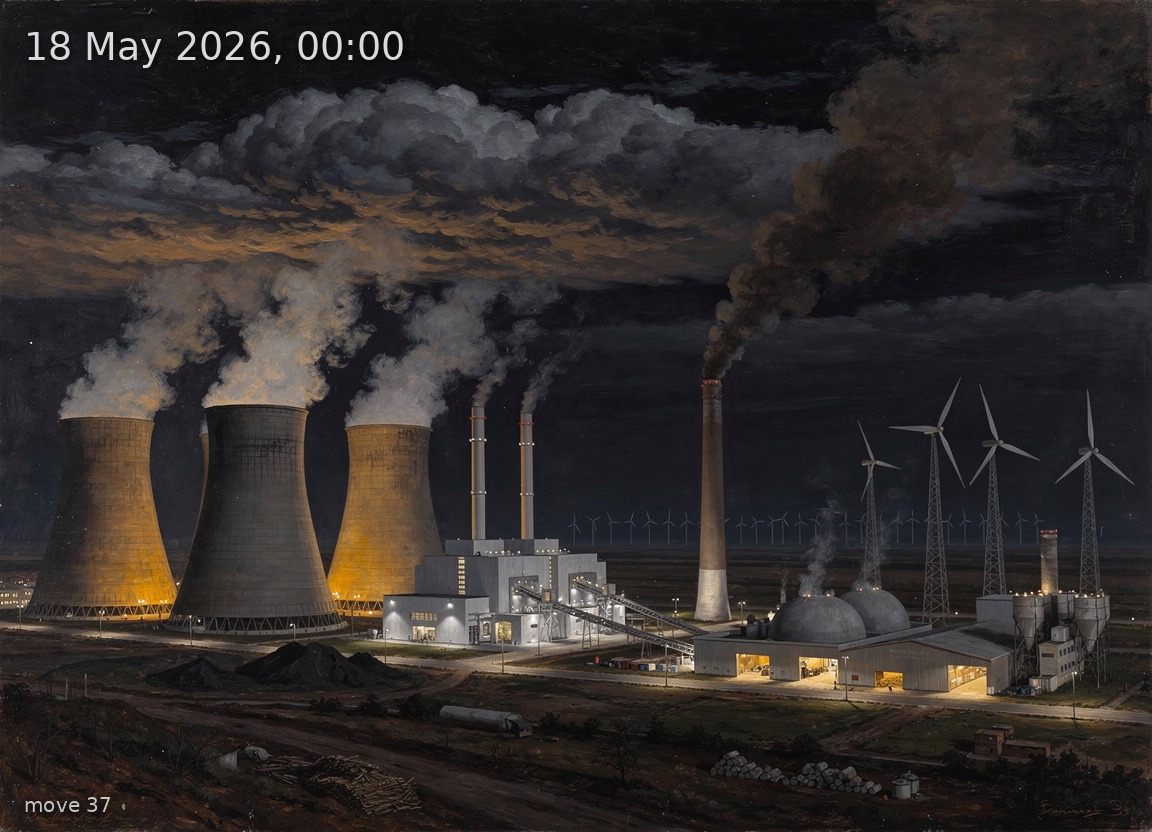
Brown coal, gas, and hard coal dominate overnight generation as calm winds and cloud cover drive high imports and elevated prices.
Back
Generation mix
Wind onshore 15%
Wind offshore 5%
Biomass 13%
Hydro 5%
Natural gas 20%
Hard coal 13%
Brown coal 28%
38%
Renewable share
6.1 GW
Wind (on + offshore)
0.0 GW
Solar
30.2 GW
Total generation
-10.9 GW
Net import
134.7 €/MWh
Day-ahead price
11.4°C / 2 km/h
Temp / Wind speed
Open-Meteo, Kassel (51.3°N 9.5°E)
97% / 0.0 W/m²
Cloud cover / Radiation
432
gCO₂/kWh
Image prompt
Brown coal 8.5 GW dominates the left third of the scene as a massive lignite power station with four hyperbolic cooling towers emitting thick white-grey steam plumes into the black sky; natural gas 6.1 GW fills the centre-left as two compact CCGT units with tall single exhaust stacks venting pale heat shimmer; hard coal 4.1 GW appears centre-right as a coal-fired station with rectangular boiler buildings and a single large chimney trailing dark smoke; wind onshore 4.6 GW occupies the right background as a scattered row of three-blade turbines on lattice towers, their rotors nearly still in the calm air; wind offshore 1.5 GW is suggested by distant turbines on a dark horizon line; biomass 4.1 GW appears as a medium-sized wood-chip-fired plant with a modest stack and warm interior glow from open loading bays; hydro 1.4 GW is a small run-of-river station with illuminated spillways at the far right edge. The time is midnight: the sky is completely black with thick 97% cloud cover obscuring all stars, no moon visible, no twilight whatsoever. The only illumination comes from sodium-orange streetlights along industrial roads, the amber and white lights of the power stations themselves, and faint glowing windows in control buildings. The atmosphere is heavy and oppressive, reflecting the high electricity price — low-hanging clouds trap the steam and industrial glow, creating an ominous amber haze above the cooling towers. Spring vegetation is barely visible in the darkness: young leaves on scattered trees, damp grass in the foreground reflecting sodium light. Temperature around 11°C suggests a cool, humid feel with condensation on metal surfaces. Highly detailed oil painting in the tradition of 19th-century German Romantic landscape painters — rich, dark palette of deep navy, burnt umber, amber, and charcoal grey with visible impasto brushwork. Each technology rendered with meticulous engineering accuracy: turbine nacelles and three-blade rotors, hyperbolic concrete cooling tower geometry, CCGT exhaust stack proportions, aluminium cladding on industrial buildings. Atmospheric depth achieved through layers of industrial haze and steam. No text, no labels.