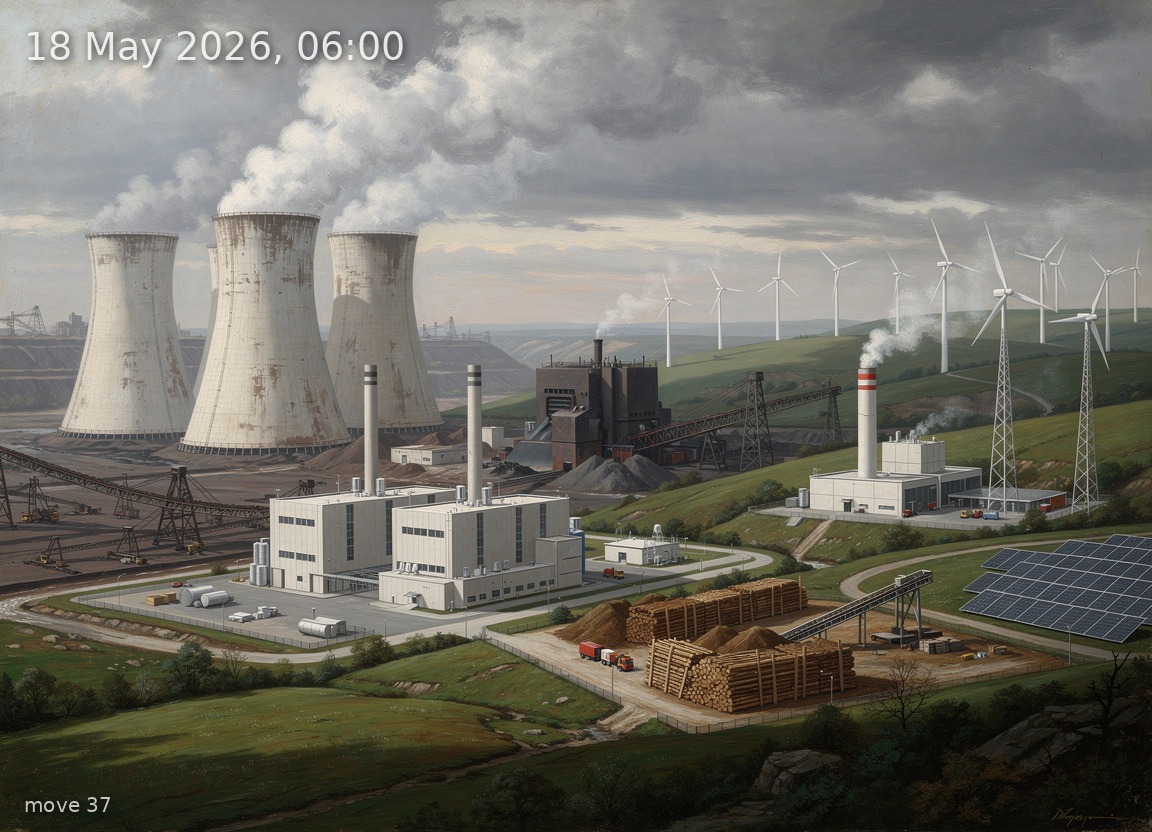
Brown coal, gas, and onshore wind lead a 34.4 GW supply against 50.7 GW demand, requiring 16.3 GW net imports under full overcast.
Back
Generation mix
Wind onshore 21%
Wind offshore 1%
Solar 9%
Biomass 12%
Hydro 4%
Natural gas 17%
Hard coal 12%
Brown coal 23%
48%
Renewable share
7.7 GW
Wind (on + offshore)
3.2 GW
Solar
34.4 GW
Total generation
-16.3 GW
Net import
152.5 €/MWh
Day-ahead price
8.9°C / 2 km/h
Temp / Wind speed
Open-Meteo, Kassel (51.3°N 9.5°E)
100% / 0.0 W/m²
Cloud cover / Radiation
362
gCO₂/kWh
Image prompt
Brown coal 8.0 GW dominates the left quarter of the scene as a cluster of four massive hyperbolic cooling towers with thick white-grey steam plumes merging into the overcast sky, alongside open-pit lignite conveyors; onshore wind 7.3 GW fills the centre-right as a long procession of three-blade turbines on lattice and tubular towers stretching across rolling green hills, rotors barely turning in near-still air; natural gas 6.0 GW occupies the centre-left as two compact CCGT power stations with tall single exhaust stacks emitting thin heat shimmer; hard coal 4.0 GW appears as a dark industrial complex with a large boiler house and conveyor gantry just behind the lignite plant; biomass 4.3 GW is rendered as a mid-sized wood-chip-fed power station with a modest stack and timber storage yard near the right foreground; solar 3.2 GW appears as a small field of aluminium-framed crystalline silicon panels in the far right middle ground, their surfaces dull and reflectionless under heavy clouds; hydro 1.3 GW is a concrete run-of-river weir with a small powerhouse visible along a river in the foreground; offshore wind 0.4 GW is barely suggested as a handful of tiny turbines on the far horizon line. The sky is a uniform heavy iron-grey overcast at 100 percent cloud cover with zero direct sunlight; the light is the pale blue-grey of early dawn at 06:00 in May — no sun disc visible, no warm tones, just the first weak pre-dawn luminance diffusing through thick stratus. The atmosphere feels heavy and oppressive, reflecting the high electricity price. Vegetation is lush spring green — birch and beech in fresh leaf — but muted by the flat lighting. The river in the foreground reflects the grey sky. Temperature around 9 °C gives a damp, cool feel with faint mist clinging to low ground. Style: highly detailed oil painting in the tradition of 19th-century German Romantic landscape painting — Caspar David Friedrich meets industrial realism — rich layered colour, visible confident brushwork, atmospheric aerial perspective, meticulous engineering detail on every turbine nacelle, every cooling tower flute, every PV cell grid line. No text, no labels, no human figures.