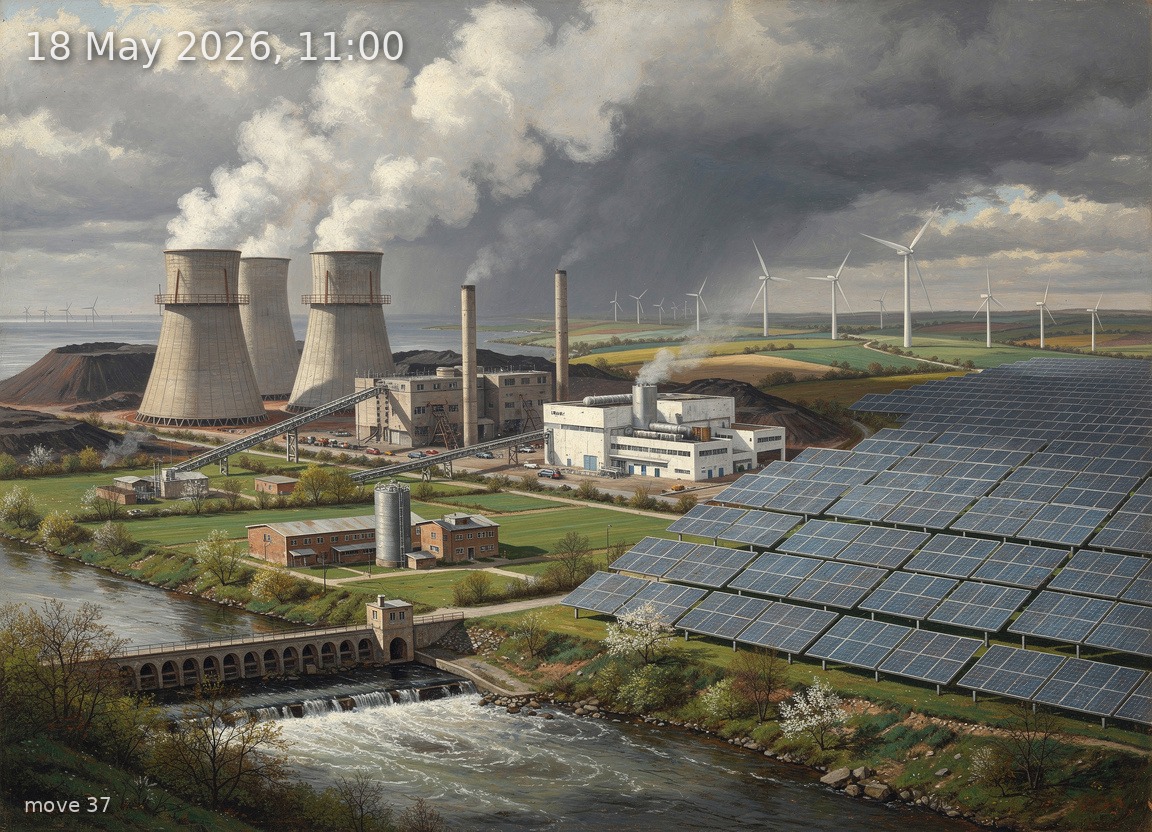
Solar leads at 38.2 GW under overcast skies; coal and gas hold firm, keeping prices at 100 EUR/MWh.
Back
Generation mix
Wind onshore 9%
Wind offshore 1%
Solar 60%
Biomass 6%
Hydro 2%
Natural gas 5%
Hard coal 6%
Brown coal 10%
79%
Renewable share
6.7 GW
Wind (on + offshore)
38.2 GW
Solar
63.8 GW
Total generation
+4.6 GW
Net export
100.0 €/MWh
Day-ahead price
14.8°C / 8 km/h
Temp / Wind speed
Open-Meteo, Kassel (51.3°N 9.5°E)
89% / 200.0 W/m²
Cloud cover / Radiation
152
gCO₂/kWh
Image prompt
Solar 38.2 GW dominates the scene as vast fields of aluminium-framed crystalline silicon PV panels stretching across the entire right half and centre-right of the composition, their blue-grey surfaces reflecting diffuse daylight under heavy overcast. Brown coal 6.3 GW occupies the far left as a cluster of massive hyperbolic cooling towers emitting thick white steam plumes that merge into the grey cloud ceiling. Hard coal 3.8 GW appears as a smaller coal-fired station with twin rectangular stacks and conveyor belts just to the right of the lignite complex. Natural gas 3.4 GW is rendered as a compact modern CCGT plant with sleek single exhaust stacks and a low turbine hall, positioned between the coal plants and the solar fields. Wind onshore 5.9 GW appears as a line of tall three-blade turbines on a ridge in the centre-background, their rotors turning slowly in light wind. Wind offshore 0.8 GW is suggested by a few distant turbines on a hazy horizon line at the far left edge. Biomass 4.1 GW appears as a mid-sized plant with a cylindrical silo and modest smokestack among green spring fields. Hydro 1.3 GW is a small run-of-river station with a weir visible along a river cutting through the foreground. The sky is 89% overcast — a heavy, oppressive blanket of stratocumulus in tones of pewter, slate, and dull ivory, with only thin gaps letting weak diffuse sunlight through, casting flat shadowless illumination typical of late morning. The atmosphere feels weighty and close, reflecting the high electricity price. Spring vegetation — fresh bright-green deciduous trees, meadows with wildflowers, rapeseed fields beginning to yellow — fills the foreground and middle ground at a temperature around 15°C. Painted in the style of a highly detailed 19th-century German Romantic oil painting — rich layered colour, visible confident brushwork, deep atmospheric perspective — yet every technology is rendered with meticulous engineering accuracy: nacelle housings, lattice tower cross-bracing, PV module junction boxes, cooling tower reinforced-concrete ribbing. No text, no labels.