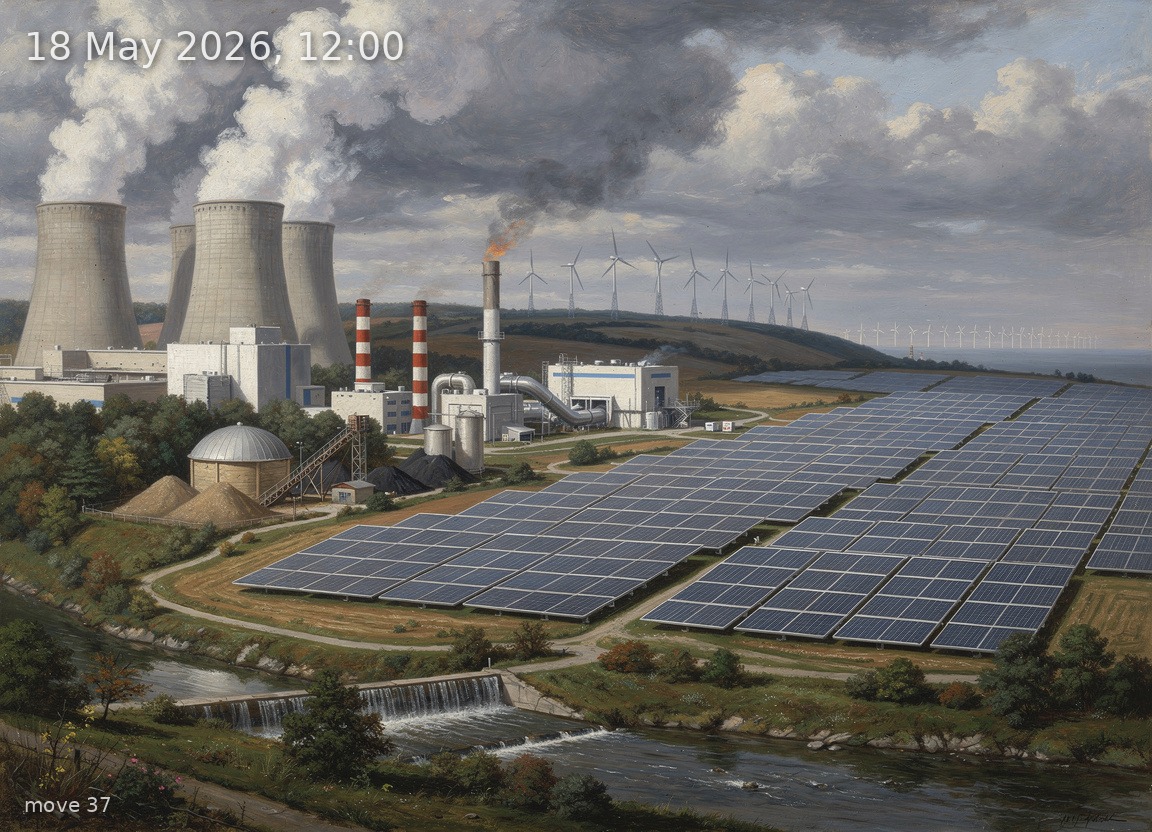
Solar at 38.4 GW leads generation under overcast skies; persistent coal and elevated prices define this midday hour.
Back
Generation mix
Wind onshore 9%
Wind offshore 2%
Solar 61%
Biomass 6%
Hydro 2%
Natural gas 5%
Hard coal 5%
Brown coal 9%
81%
Renewable share
7.0 GW
Wind (on + offshore)
38.4 GW
Solar
62.7 GW
Total generation
+4.2 GW
Net export
94.9 €/MWh
Day-ahead price
15.7°C / 11 km/h
Temp / Wind speed
Open-Meteo, Kassel (51.3°N 9.5°E)
95% / 369.0 W/m²
Cloud cover / Radiation
137
gCO₂/kWh
Image prompt
Solar 38.4 GW dominates the scene as a vast expanse of aluminium-framed crystalline silicon photovoltaic panels stretching across rolling farmland, covering roughly sixty percent of the composition from centre to right; brown coal 5.9 GW occupies the far left as a cluster of massive hyperbolic concrete cooling towers with thick white steam plumes rising into heavy clouds; hard coal 3.1 GW appears just left of centre as a smaller coal plant with twin chimneys and conveyor belts feeding dark fuel; natural gas 2.9 GW sits as a compact combined-cycle gas turbine facility with a single tall exhaust stack and visible heat shimmer near the coal complex; wind onshore 5.8 GW is rendered as a line of modern three-blade turbines on lattice towers along a distant ridge behind the solar field, blades turning slowly in light wind; wind offshore 1.2 GW appears as a faint row of turbines on the far-right horizon above a sliver of grey sea; biomass 4.0 GW is a mid-sized plant with a wood-chip storage dome and modest smokestack set among trees at centre-left; hydro 1.3 GW is a small run-of-river weir with turbine house visible along a river cutting through the foreground. The sky is heavily overcast at 95% cloud cover — a thick, oppressive blanket of grey-white stratocumulus — yet bright diffuse midday light floods the landscape from above, casting soft shadowless illumination consistent with noon in May. Gaps in the cloud layer allow shafts of direct sunlight to strike the solar panels, making them gleam. Spring vegetation: fresh green grass, budding deciduous trees, rapeseed fields in yellow bloom at 15.7 °C. The atmosphere feels heavy and close, reflecting the elevated 94.9 EUR/MWh price — a brooding, weighty quality to the air. Style: highly detailed oil painting in the tradition of 19th-century German Romantic landscape painters such as Caspar David Friedrich and Carl Blechen — rich layered colour, visible confident brushwork, deep atmospheric perspective, dramatic cloud study — but with meticulous modern engineering accuracy in every turbine nacelle, PV module, cooling tower, and smokestack. No text, no labels.