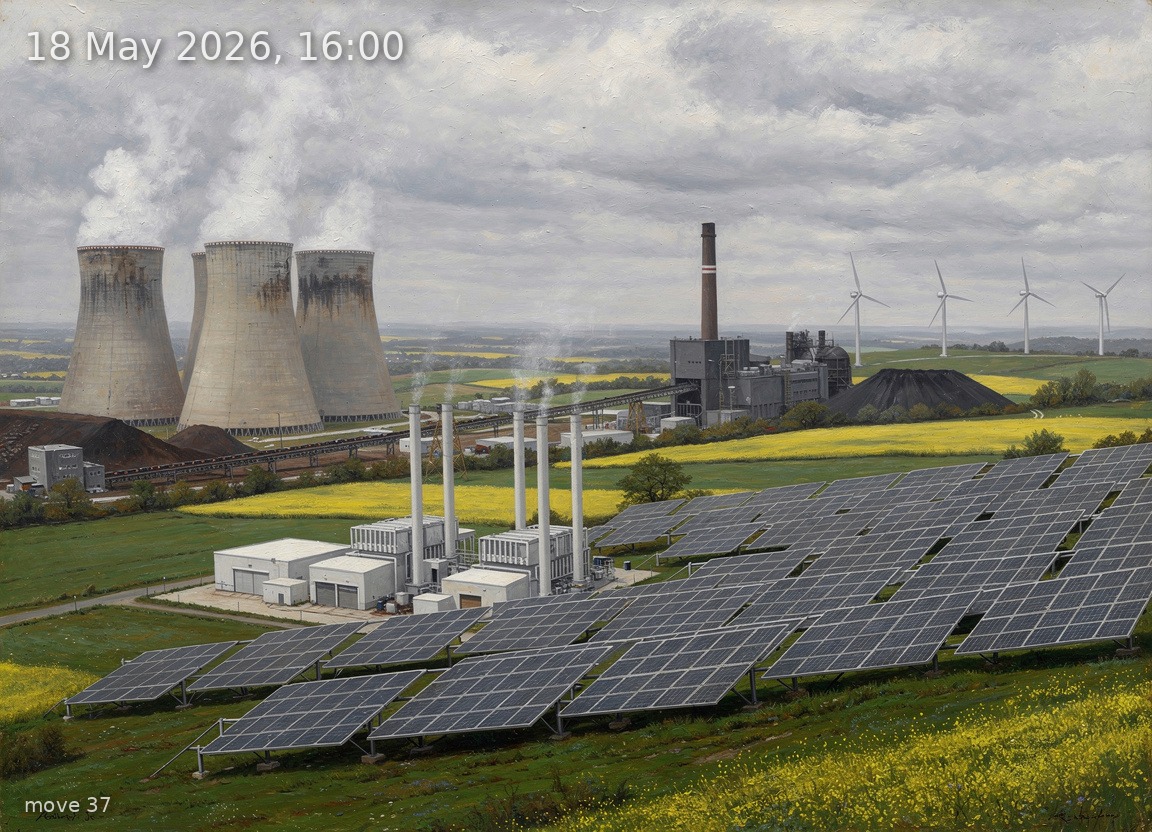
Solar leads at 26.2 GW under overcast skies, with lignite and gas supporting a tight supply-demand balance.
Back
Generation mix
Wind onshore 8%
Wind offshore 1%
Solar 49%
Biomass 8%
Hydro 2%
Natural gas 9%
Hard coal 7%
Brown coal 16%
68%
Renewable share
4.6 GW
Wind (on + offshore)
26.2 GW
Solar
53.0 GW
Total generation
-1.3 GW
Net import
114.0 €/MWh
Day-ahead price
17.6°C / 9 km/h
Temp / Wind speed
Open-Meteo, Kassel (51.3°N 9.5°E)
100% / 107.0 W/m²
Cloud cover / Radiation
227
gCO₂/kWh
Image prompt
Solar 26.2 GW dominates the right half and centre-right of the scene as vast fields of aluminium-framed crystalline silicon PV panels stretching across gently rolling green farmland under diffuse grey light; brown coal 8.6 GW occupies the left quarter as a cluster of massive hyperbolic concrete cooling towers emitting thick white steam plumes rising into the overcast sky, with a conveyor belt carrying dark lignite visible at the plant base; natural gas 4.5 GW appears centre-left as two compact CCGT power stations with tall slender exhaust stacks and thin heat-shimmer exhaust; hard coal 3.7 GW sits behind the gas plant as a single large facility with a prominent smokestack and coal stockpile; wind onshore 4.1 GW is rendered as a modest row of five three-blade turbines on a distant ridge, their rotors turning very slowly in faint wind; wind offshore 0.5 GW appears as two tiny turbines barely visible on a far hazy horizon line; biomass 4.1 GW is shown as a mid-sized wood-chip-fired plant with a rounded silo and modest chimney near the solar fields; hydro 1.3 GW appears as a small dam and powerhouse tucked into a wooded valley in the far background. TIME: 16:00 full afternoon daylight, but completely overcast — a uniform blanket of grey-white stratus clouds covers the entire sky, no blue patches, no direct sunlight, flat diffuse illumination casting almost no shadows. The atmosphere feels heavy and oppressive, reflecting a high electricity price — the air is thick, slightly hazy, with a muted colour palette. Spring vegetation: lush green meadows, blooming rapeseed fields in muted yellow, deciduous trees in full bright-green leaf. Temperature mild at 17.6°C. Rendered as a highly detailed oil painting in the tradition of 19th-century German Romantic landscape painters such as Caspar David Friedrich and Carl Blechen — rich layered colour, visible impasto brushwork, atmospheric depth with sfumato haze in the distance, dramatic compositional tension between industrial infrastructure and pastoral landscape. Each energy technology rendered with meticulous engineering accuracy: turbine nacelles with three-blade rotors on lattice or tubular towers, PV panels with visible cell grid patterns and metal frames, lignite cooling towers with correct hyperboloid geometry. No text, no labels, no people prominently featured.