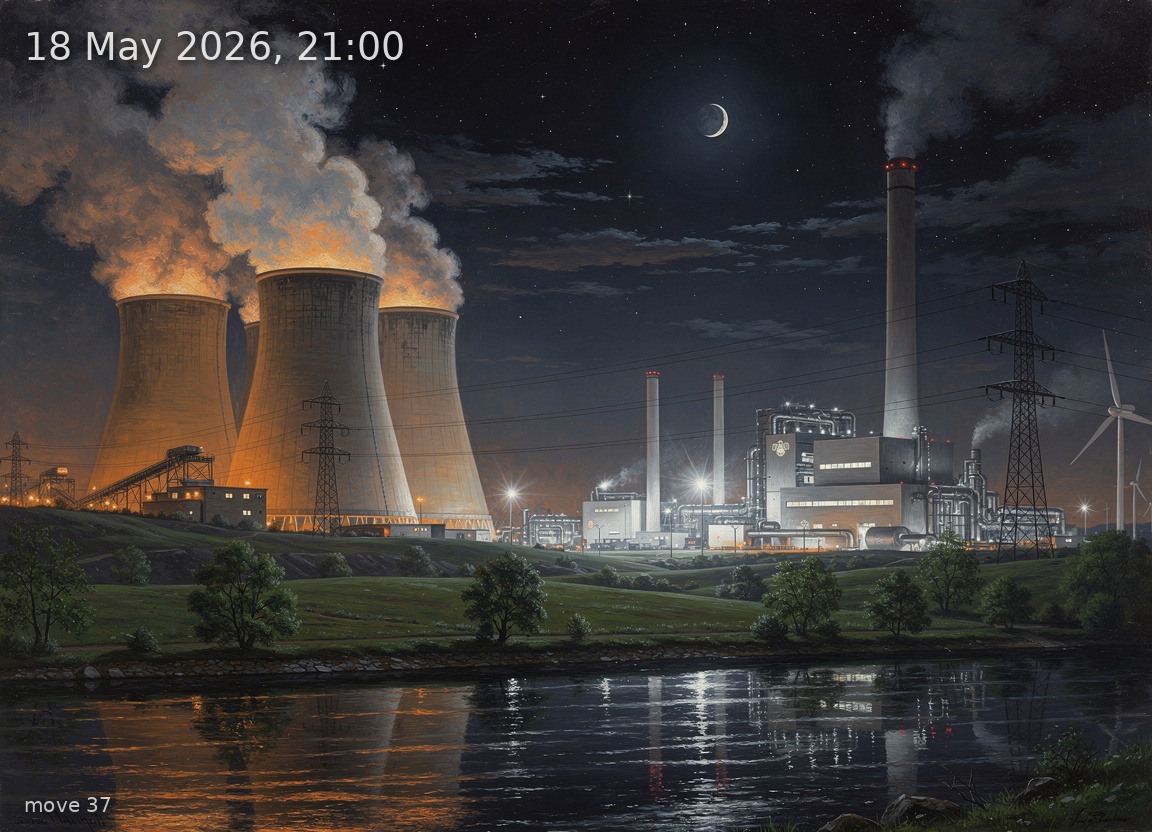
Brown coal, gas, and hard coal dominate domestic generation as zero solar and low wind force heavy net imports at nightfall.
Back
Generation mix
Wind onshore 19%
Wind offshore 2%
Solar 0%
Biomass 14%
Hydro 5%
Natural gas 21%
Hard coal 12%
Brown coal 28%
39%
Renewable share
6.6 GW
Wind (on + offshore)
0.0 GW
Solar
32.3 GW
Total generation
-20.5 GW
Net import
214.3 €/MWh
Day-ahead price
12.6°C / 2 km/h
Temp / Wind speed
Open-Meteo, Kassel (51.3°N 9.5°E)
6% / 15.0 W/m²
Cloud cover / Radiation
420
gCO₂/kWh
Image prompt
Brown coal 9.0 GW occupies the left third of the scene as a massive lignite power station with four hyperbolic cooling towers emitting thick white steam plumes lit from below by orange sodium lamps; natural gas 6.9 GW fills the centre-left as a pair of modern CCGT plants with tall slender exhaust stacks trailing thin heat shimmer; hard coal 3.8 GW appears centre-right as a single large coal-fired station with a rectangular boiler house and a single wide chimney stack with faint grey exhaust; onshore wind 6.1 GW spans the right quarter as a scattered row of tall three-blade turbines on lattice-free tubular towers, blades barely rotating in the still air; biomass 4.4 GW appears as a modest wood-chip-fed CHP plant with a short stack and warm amber-lit building near the wind turbines; hydro 1.6 GW is suggested by a small concrete dam with illuminated spillway in the far right background; offshore wind 0.5 GW is a faint silhouette of two turbines on the distant horizon line. TIME AND ATMOSPHERE: full night, 21:00 in May — the sky is deep navy-black, completely dark with no twilight glow, scattered bright stars visible through only 6% cloud cover; a waxing crescent moon sits low. The landscape is a gently rolling central German plain with fresh spring-green grass and leafy deciduous trees in full canopy, all visible only under artificial light. Sodium-orange and white LED industrial lighting illuminates each power station, casting long warm reflections on a calm river running through the foreground. The overall atmosphere is heavy and oppressive despite clear skies, conveying the tension of a 214 EUR/MWh price — a brooding industrial weight hangs over the scene. Thick power transmission lines on steel lattice pylons run across the middle ground, symbolising the massive import flows. Style: highly detailed oil painting in the tradition of 19th-century German Romantic landscape painters such as Caspar David Friedrich and Carl Blechen — rich impasto brushwork, dramatic chiaroscuro between the dark sky and the glowing industrial complexes, deep atmospheric perspective, luminous treatment of steam and artificial light against the night. Every technology rendered with meticulous engineering accuracy: turbine nacelles, three-blade rotors, aluminium cooling tower frameworks, CCGT heat-recovery steam generators. No text, no labels.