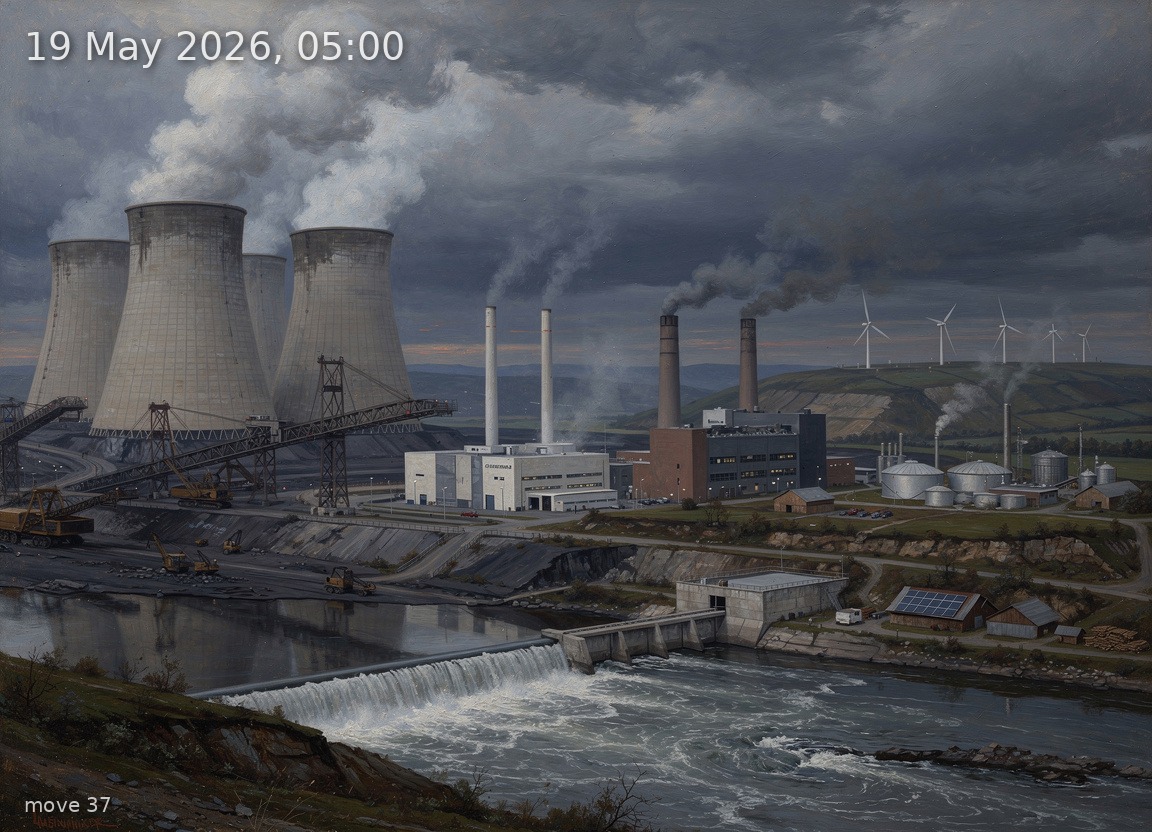
Brown coal and gas dominate a 29 GW domestic supply requiring 17.3 GW net imports under calm, overcast pre-dawn conditions.
Back
Generation mix
Wind onshore 10%
Wind offshore 1%
Solar 1%
Biomass 14%
Hydro 5%
Natural gas 24%
Hard coal 13%
Brown coal 32%
31%
Renewable share
3.1 GW
Wind (on + offshore)
0.3 GW
Solar
29.0 GW
Total generation
-17.3 GW
Net import
146.9 €/MWh
Day-ahead price
7.1°C / 1 km/h
Temp / Wind speed
Open-Meteo, Kassel (51.3°N 9.5°E)
100% / 0.0 W/m²
Cloud cover / Radiation
476
gCO₂/kWh
Image prompt
Brown coal 9.2 GW dominates the left third of the scene as a cluster of massive hyperbolic cooling towers with thick white-grey steam plumes merging into the overcast sky, surrounded by lignite conveyors and open-pit mining infrastructure; natural gas 7.0 GW fills the centre-left as two compact CCGT plants with tall slender exhaust stacks emitting thin heat shimmer; hard coal 3.8 GW appears centre-right as a traditional coal-fired station with a large rectangular boiler house and twin chimneys; biomass 4.2 GW is rendered as a group of medium-sized wood-pellet and biogas plants with rounded digesters and modest stacks, set among agricultural buildings; onshore wind 3.0 GW appears as a sparse row of three-blade turbines on a distant ridge, rotors barely moving in the near-still air; hydro 1.5 GW is a concrete run-of-river dam in the middle distance with water spilling white; solar 0.3 GW is almost invisible — a few aluminium-framed panels on a barn roof, dark and unreflective under heavy cloud; offshore wind 0.2 GW is a single distant turbine silhouette on a far horizon line. The sky is pre-dawn deep blue-grey, 05:00 first light barely brightening the eastern horizon with the faintest band of cold steel-blue; no direct sunlight, no warm colours in the sky; 100% cloud cover creates a heavy, oppressive low ceiling of stratus. Temperature 7°C: fresh green May foliage on scattered trees but with a damp chill visible as mist clinging to the river valley. The atmosphere feels weighty and expensive — thick industrial haze blurs the middle distance, sodium-orange lights still glow at each power station. Highly detailed oil painting in the tradition of 19th-century German Romantic landscape painters — Caspar David Friedrich meets industrial sublime — rich sombre colour palette of slate blues, umber browns, and ash greys, visible impasto brushwork, deep atmospheric perspective. Every technology rendered with meticulous engineering accuracy: three-blade rotors with nacelles and lattice towers, hyperbolic concrete cooling towers with internal ribbing visible, CCGT stacks with heat-distortion detail. No text, no labels.