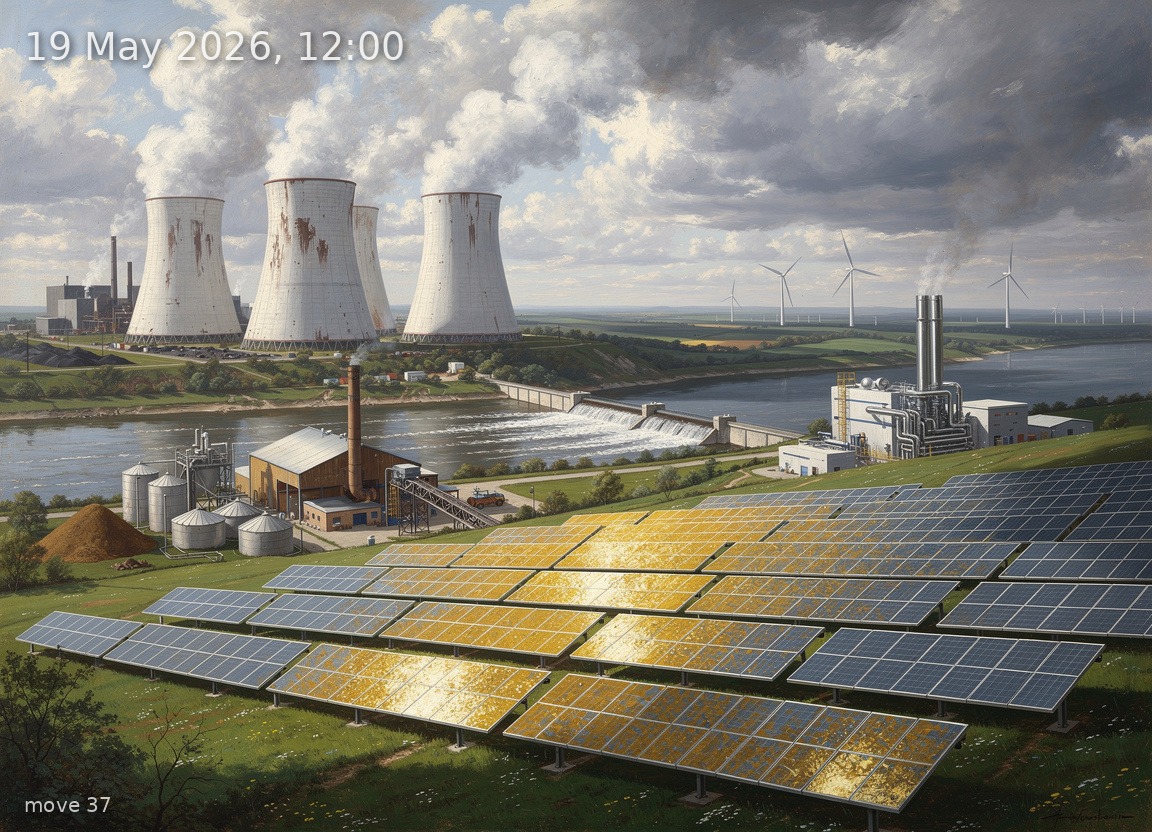
Solar at 42 GW drives 68% of generation at midday; brown coal and thermal units hold baseload beneath broken clouds.
Back
Generation mix
Wind onshore 5%
Wind offshore 2%
Solar 68%
Biomass 6%
Hydro 2%
Natural gas 4%
Hard coal 4%
Brown coal 9%
84%
Renewable share
4.3 GW
Wind (on + offshore)
42.0 GW
Solar
61.6 GW
Total generation
+5.8 GW
Net export
73.2 €/MWh
Day-ahead price
15.8°C / 9 km/h
Temp / Wind speed
Open-Meteo, Kassel (51.3°N 9.5°E)
88% / 451.0 W/m²
Cloud cover / Radiation
117
gCO₂/kWh
Image prompt
Solar 42.0 GW dominates the entire foreground and middle ground as vast fields of aluminium-framed crystalline silicon PV panels stretching across rolling green spring meadows, angled south, catching intense light through cloud gaps. Brown coal 5.3 GW occupies the left background as a cluster of four massive hyperbolic cooling towers emitting thick white steam plumes rising into overcast sky. Biomass 4.0 GW appears as a mid-sized industrial plant with a tall chimney and wood-chip storage silos at centre-left. Wind onshore 3.1 GW shows as a scattered line of five three-blade turbines on a distant ridge, blades turning slowly in light wind. Natural gas 2.3 GW is rendered as a compact CCGT plant with a single polished exhaust stack and modest heat shimmer, positioned at centre-right. Hard coal 2.3 GW appears as a smaller coal plant with a single rectangular cooling tower and conveyor belt, near the brown coal complex. Hydro 1.4 GW is a small concrete run-of-river weir visible along a river cutting through the valley floor. Wind offshore 1.2 GW is barely visible as tiny turbine silhouettes on the far horizon. The sky is midday bright but heavily overcast at 88% cloud cover, with dramatic breaks in the thick grey-white cumulus layer allowing shafts of brilliant direct sunlight to pour through, illuminating the solar fields in patches of intense gold while other areas remain in cloud shadow. The atmosphere feels slightly oppressive and warm-humid, hinting at the 73 EUR price tension — a heavy silvery haze hangs at the horizon. Spring vegetation at 15.8°C: fresh bright-green deciduous trees in full leaf, wildflowers in meadow margins, lush grass. Painted in the style of a highly detailed 19th-century German Romantic oil painting — rich layered colour, visible impasto brushwork, atmospheric depth reminiscent of Caspar David Friedrich merged with industrial realism. Meticulous engineering detail on every technology: turbine nacelles with three-blade rotors on lattice towers, precise PV module gridlines, cooling tower parabolic geometry with condensation trails. No text, no labels.