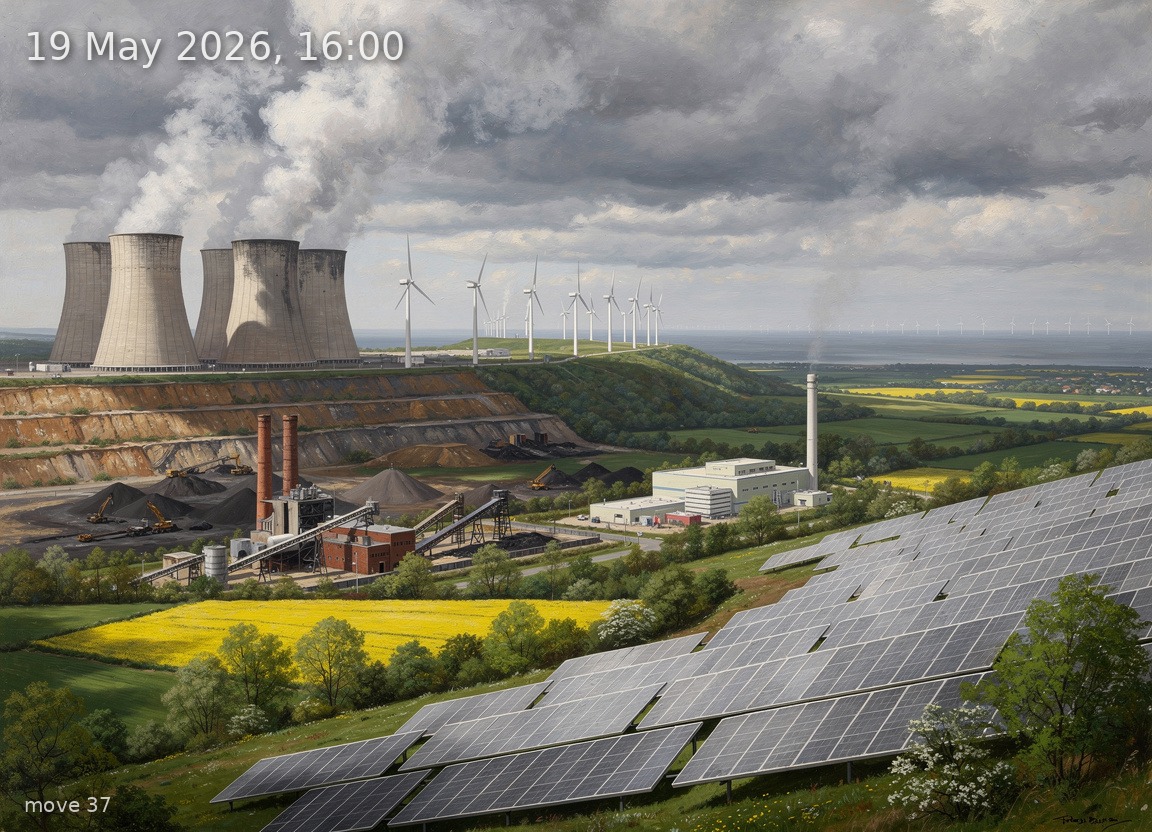
Solar leads at 26.2 GW under overcast skies; brown coal and thermal plants fill the 20.4 GW residual load.
Back
Generation mix
Wind onshore 10%
Wind offshore 4%
Solar 49%
Biomass 8%
Hydro 3%
Natural gas 6%
Hard coal 6%
Brown coal 15%
73%
Renewable share
7.7 GW
Wind (on + offshore)
26.2 GW
Solar
53.9 GW
Total generation
-0.5 GW
Net import
102.2 €/MWh
Day-ahead price
17.0°C / 10 km/h
Temp / Wind speed
Open-Meteo, Kassel (51.3°N 9.5°E)
93% / 125.0 W/m²
Cloud cover / Radiation
196
gCO₂/kWh
Image prompt
Solar 26.2 GW dominates the right half of the canvas as vast expanses of aluminium-framed crystalline silicon photovoltaic panels stretching across gentle rolling farmland, their glass surfaces reflecting diffuse grey-white light from a heavily overcast sky. Brown coal 8.0 GW occupies the left quarter as a cluster of massive hyperbolic concrete cooling towers with thick white-grey steam plumes rising and merging into the low cloud ceiling, adjacent to open-pit mine terraces in ochre and brown. Wind onshore 5.3 GW appears as a line of modern three-blade turbines with white tubular towers and nacelles turning slowly on a distant ridge in the centre-left midground. Wind offshore 2.4 GW is suggested by a faint row of turbines visible on the far horizon line. Biomass 4.1 GW appears centre-right as a modest industrial facility with timber-clad walls and a single smokestack emitting thin pale vapour, surrounded by woodchip piles. Natural gas 3.1 GW is rendered as a compact CCGT plant with a tall single exhaust stack and low rectangular buildings near the centre. Hard coal 3.3 GW appears as a coal-fired station with a pair of tall brick chimneys and conveyor belts to the left of centre. Hydro 1.5 GW is a small dam with spillway in the far left background nestled in forested hills. Time is 4 PM in late May: full daylight but with a thick, 93% overcast sky casting flat, even illumination with no shadows; the atmosphere feels heavy and slightly oppressive, hinting at the high electricity price. The temperature is mild at 17°C; vegetation is lush late-spring green — beech and oak in full leaf, rapeseed fields adding flecks of yellow. Wind is gentle at 10 km/h, barely ruffling grass. Style: highly detailed oil painting in the tradition of 19th-century German Romantic landscape masters such as Caspar David Friedrich and Carl Blechen — rich layered colour, visible impasto brushwork, atmospheric aerial perspective with subtle gradations in the overcast sky, meticulous engineering detail on every turbine blade, panel frame, and cooling tower rib. The composition balances industrial grandeur with pastoral depth. No text, no labels, no human figures dominating the scene.