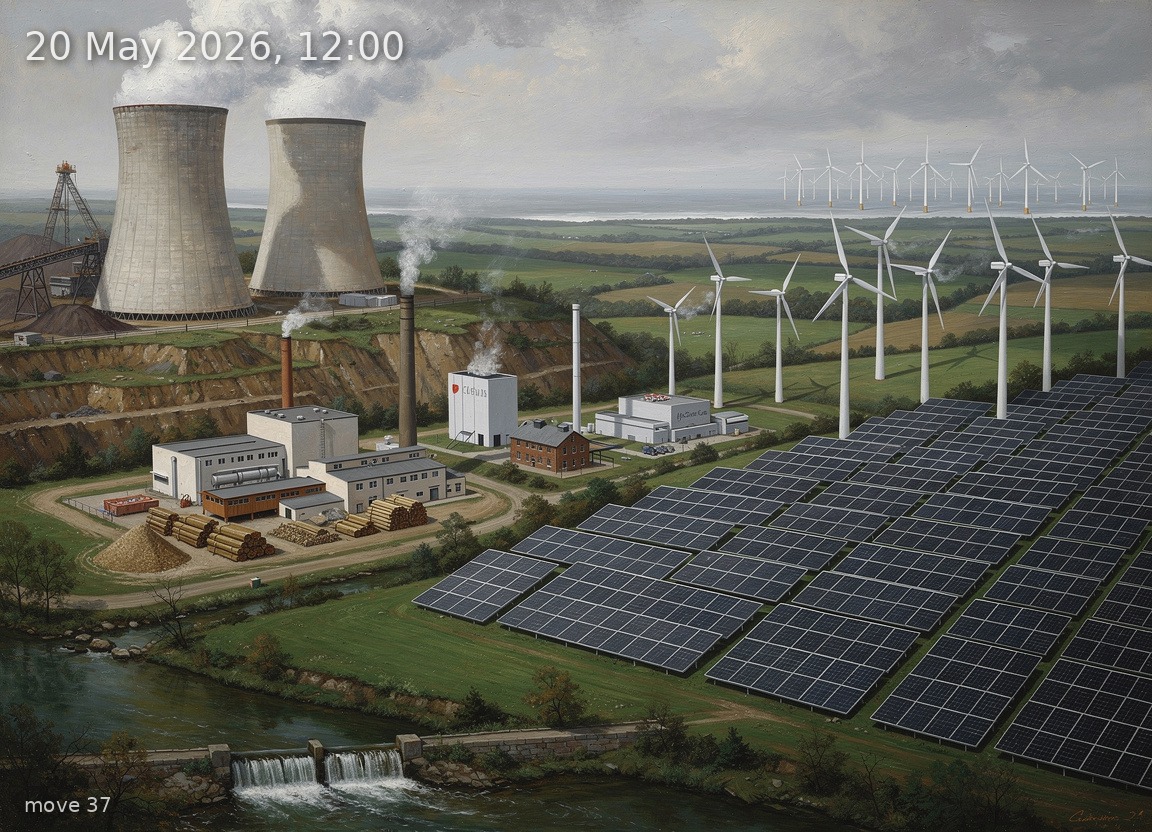
Overcast solar at 27 GW leads generation, supported by 18.7 GW wind, with coal and gas filling the 13.7 GW residual load.
Back
Generation mix
Wind onshore 23%
Wind offshore 8%
Solar 45%
Biomass 7%
Hydro 2%
Natural gas 4%
Hard coal 2%
Brown coal 8%
85%
Renewable share
18.7 GW
Wind (on + offshore)
27.0 GW
Solar
59.6 GW
Total generation
+0.2 GW
Net export
64.0 €/MWh
Day-ahead price
15.3°C / 9 km/h
Temp / Wind speed
Open-Meteo, Kassel (51.3°N 9.5°E)
99% / 48.0 W/m²
Cloud cover / Radiation
105
gCO₂/kWh
Image prompt
Solar 27.0 GW dominates the centre and right of the composition as vast fields of aluminium-framed crystalline silicon photovoltaic panels stretching across rolling green May farmland, their surfaces reflecting flat grey-white light; wind onshore 13.8 GW appears as dozens of tall three-blade turbines with white tubular towers and nacelles arrayed across gentle hills in the mid-ground, blades turning slowly in light breeze; wind offshore 4.9 GW is visible on the far horizon as a cluster of offshore turbines rising from a pale grey North Sea strip; brown coal 4.9 GW occupies the far left as two massive hyperbolic concrete cooling towers emitting thick white steam plumes, alongside a lignite conveyor and open-pit edge; biomass 4.0 GW sits left-of-centre as a medium-sized wood-chip power plant with a compact stack and thin pale exhaust and stacked timber logs; natural gas 2.3 GW is rendered as a sleek CCGT facility with a single tall exhaust stack and thin heat shimmer, placed between the coal plant and the biomass facility; hard coal 1.5 GW appears as a smaller conventional boiler house with a dark brick chimney beside the brown coal towers; hydro 1.2 GW is a modest run-of-river weir with a small turbine house beside a green-banked river in the lower foreground. Time of day is noon under full overcast: the sky is a uniform blanket of heavy grey-white stratus clouds with no blue patches and no direct sun, yet the scene is fully and evenly daylit with soft diffuse illumination and no harsh shadows. Spring vegetation is lush—fresh bright-green deciduous foliage, rape fields not yet fully yellow, wildflowers along field margins. The atmosphere feels mildly oppressive, with a low heavy ceiling pressing down—reflecting the 64 EUR/MWh price. Style: highly detailed oil painting in the tradition of 19th-century German Romantic landscape masters such as Caspar David Friedrich and Carl Blechen—rich layered colour, visible impasto brushwork, atmospheric aerial perspective receding into misty industrial distance—but with meticulous engineering accuracy for each technology: correct turbine nacelle proportions, PV module grid patterns, hyperbolic cooling tower geometry, CCGT exhaust stack detail. No text, no labels, no people in foreground.