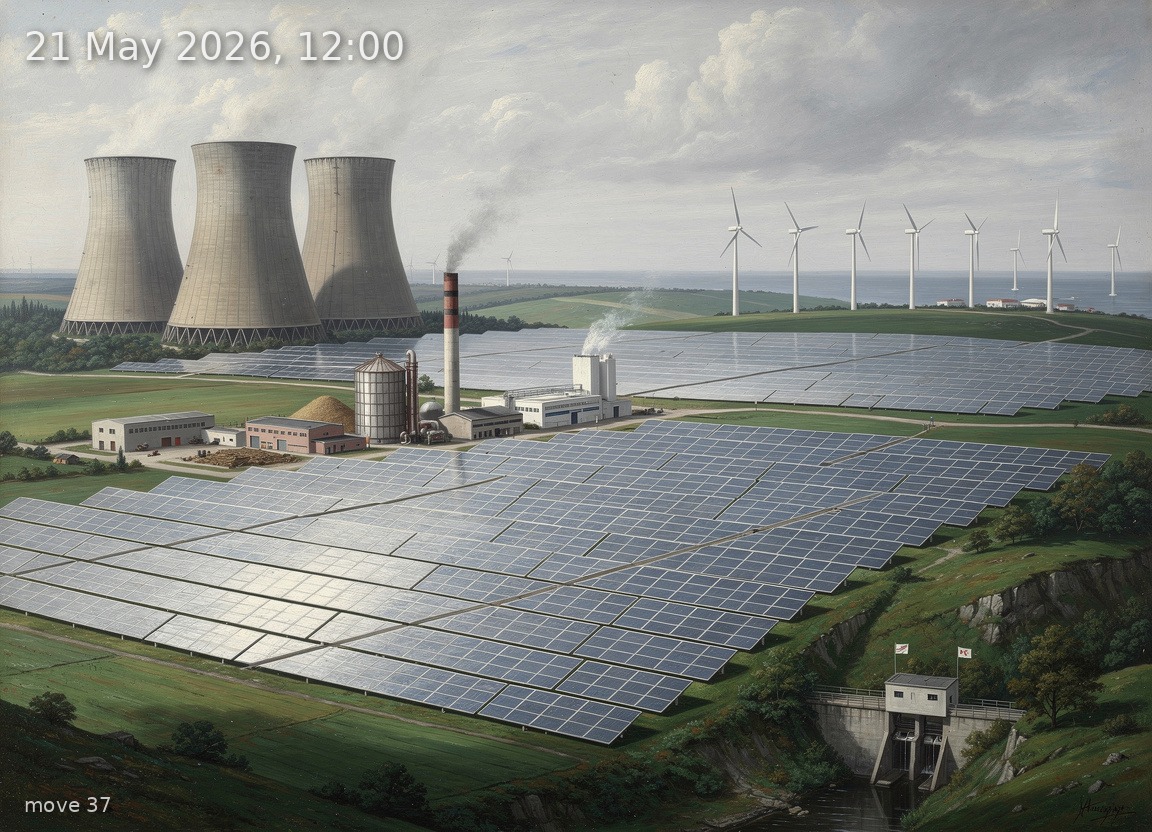
Solar provides 38.3 GW at midday under overcast skies, with brown coal and biomass supplying baseload at a low 12.1 EUR/MWh price.
Back
Generation mix
Wind onshore 11%
Wind offshore 3%
Solar 65%
Biomass 7%
Hydro 2%
Natural gas 4%
Hard coal 2%
Brown coal 8%
86%
Renewable share
7.8 GW
Wind (on + offshore)
38.3 GW
Solar
59.3 GW
Total generation
+2.8 GW
Net export
12.1 €/MWh
Day-ahead price
18.5°C / 5 km/h
Temp / Wind speed
Open-Meteo, Kassel (51.3°N 9.5°E)
83% / 266.0 W/m²
Cloud cover / Radiation
98
gCO₂/kWh
Image prompt
Solar 38.3 GW dominates the scene as a vast expanse of crystalline silicon PV panels stretching across rolling green fields occupying roughly two-thirds of the canvas, their aluminium frames catching diffuse silver-white light; brown coal 4.7 GW appears in the left background as a cluster of three massive hyperbolic cooling towers with pale steam plumes rising into the hazy sky; biomass 3.9 GW is rendered as a mid-sized industrial facility with a wood-chip silo and low smokestack near the left-centre; natural gas 2.1 GW sits as a compact CCGT plant with a single tall exhaust stack and modest heat shimmer, positioned centre-left; wind onshore 6.3 GW appears as a line of eight three-blade turbines on a distant ridge to the right, their rotors barely turning in the light breeze; wind offshore 1.5 GW is suggested by two turbines on the far-right horizon above a faint grey sea line; hydro 1.3 GW is a small dam and powerhouse nestled in a green valley at far right; hard coal 1.2 GW is a single industrial stack with a thin dark plume beside the brown coal complex. The sky is overcast at 83% cloud cover but luminous—a bright, high haze with patches of pale blue breaking through, full midday daylight at noon in late May. The temperature of 18.5°C shows in lush green spring vegetation, wildflowers along field margins, fresh deciduous canopy. The low electricity price of 12.1 EUR/MWh is conveyed by a calm, open, unhurried atmosphere—no oppressive weight, gentle pastoral ease despite the industrial elements. Painted in the style of a highly detailed 19th-century German Romantic landscape oil painting—rich saturated greens and silvery greys, visible confident brushwork, atmospheric aerial perspective with haze softening distant elements, meticulous engineering detail on every turbine nacelle, every PV module edge, every cooling tower's concrete ribbing. No text, no labels.