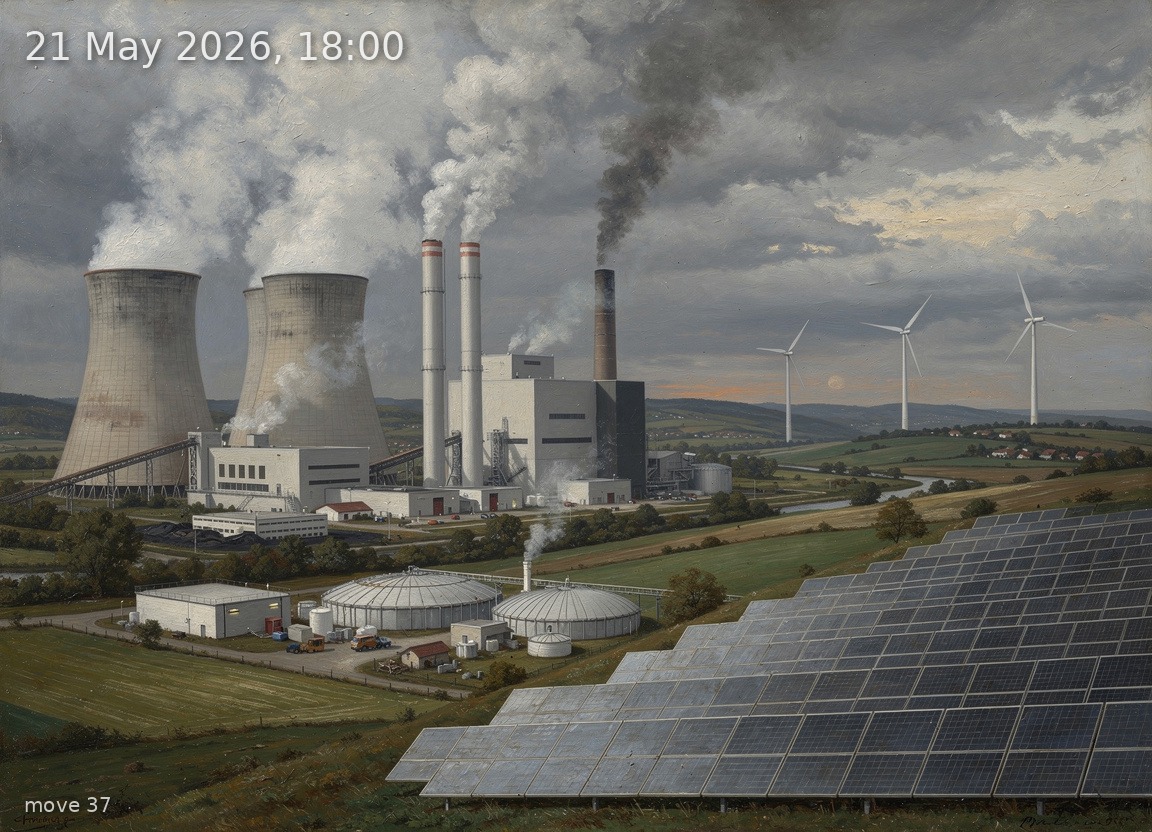
Brown coal and solar lead generation as low winds and overcast skies drive elevated prices and net imports.
Back
Generation mix
Wind onshore 10%
Wind offshore 5%
Solar 31%
Biomass 10%
Hydro 4%
Natural gas 12%
Hard coal 7%
Brown coal 22%
59%
Renewable share
6.8 GW
Wind (on + offshore)
14.1 GW
Solar
45.3 GW
Total generation
-7.3 GW
Net import
135.9 €/MWh
Day-ahead price
20.2°C / 2 km/h
Temp / Wind speed
Open-Meteo, Kassel (51.3°N 9.5°E)
99% / 80.0 W/m²
Cloud cover / Radiation
290
gCO₂/kWh
Image prompt
Solar 14.1 GW occupies the right third of the scene as vast fields of aluminium-framed crystalline silicon PV panels stretching across gentle rolling farmland, their surfaces reflecting only dull grey light. Brown coal 9.9 GW dominates the left quarter as a massive lignite power station complex with four hyperbolic cooling towers emitting thick white-grey steam plumes that merge into the overcast sky. Natural gas 5.2 GW appears in the centre-left as two compact CCGT units with tall single exhaust stacks trailing thin heat shimmer. Wind onshore 4.5 GW is rendered as a scattered line of five three-blade turbines on distant hills, their rotors nearly motionless in the calm air. Biomass 4.3 GW appears as a mid-ground industrial biogas facility with cylindrical digesters and a small chimney with faint exhaust. Hard coal 3.3 GW sits beside the brown coal complex as a smaller conventional power station with a single rectangular stack. Wind offshore 2.3 GW is suggested at the far horizon as tiny turbine silhouettes beyond a hazy coastal line. Hydro 1.7 GW is a small dam with a reservoir visible in the far right middle ground. The sky is 99% overcast: a thick, heavy, oppressive blanket of uniform grey-white stratus clouds covering the entire sky, pressing down on the landscape. Time is 18:00 in late May — dusk is beginning, with a faint warm orange-amber glow seeping through a narrow band at the western horizon beneath the cloud deck, while the upper sky transitions from grey to a muted steel-blue. The atmosphere feels heavy and humid at 20°C; lush green late-spring vegetation — tall grass, leafy deciduous trees in full canopy — fills the foreground. Air is still, no motion in grass or leaves. The high electricity price is conveyed through the oppressive, weighty, smothering quality of the low cloud ceiling and the dominance of industrial smoke and steam. Style: highly detailed oil painting in the tradition of 19th-century German Romantic landscape painters such as Caspar David Friedrich and Carl Blechen — rich, layered colour with visible impasto brushwork, dramatic atmospheric depth, chiaroscuro interplay between the fading dusk glow and the industrial emissions. Meticulous engineering accuracy on all infrastructure. No text, no labels, no people prominent.